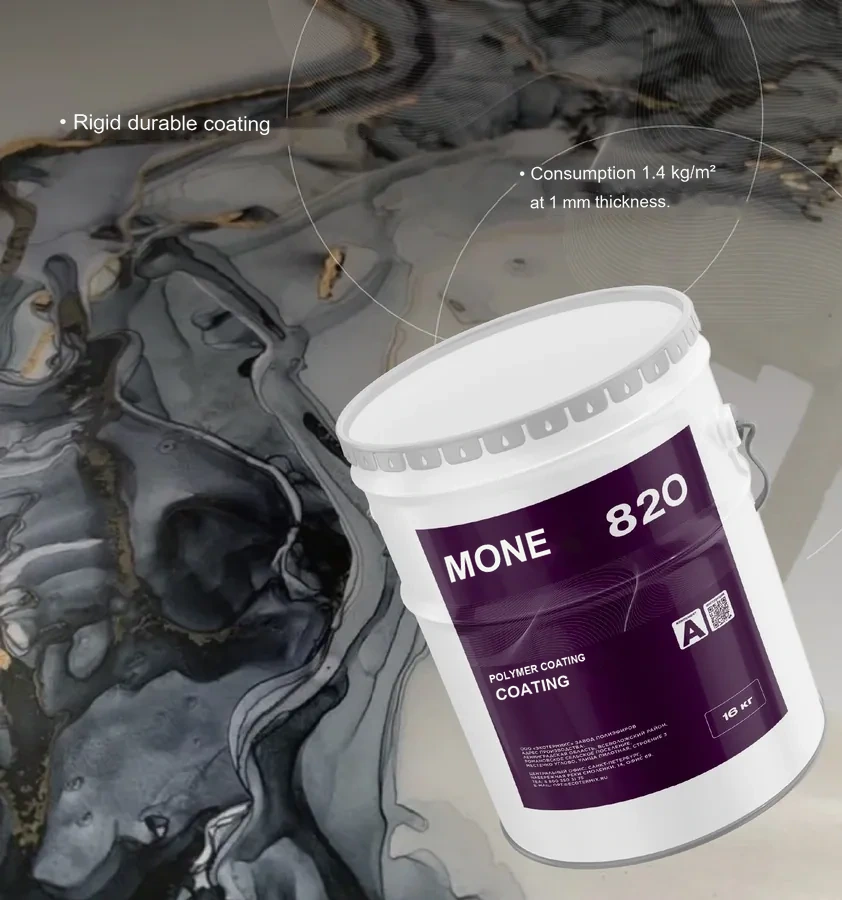
Epoxy Self-Levelling Floor MONE 820
Two-component epoxy self-levelling floor MONE 820
Description
Two-component epoxy composition MONE 820 for creating a polymer self-levelling floor coating. Protects concrete or other mineral substrates from mechanical and chemical impact and gives a decorative appearance. The resulting glossy, mirror-smooth coating features increased hardness. Without the addition of a colorant, it remains transparent and can be used to protect decorative floor coverings and graphic images. Quartz sand is used to create a non-slip texture.
Properties
In terms of technological properties, epoxy self-levelling floor MONE 820 must comply with the requirements specified in Table 1.
Table 1
|
Parameter |
Value |
Test method |
|
Appearance |
Visual |
Smooth, glossy, pigmented coating. Can be colour-matched using the Ecotermix colour chart. The material can also be transparent. |
|
Density, g/cm3 |
1.45 |
GOST 56379 |
|
Hardness, Shore D |
75 |
DIN 53505 (after 7 days at +23°C) |
|
Impact strength, kJ/m2 |
44 |
EN ISO 179 |
|
Abrasion resistance (Taber), mg/1000 |
40-42 |
DIN 52347 |
|
Tensile strength, MPa |
29 |
EN ISO 527 |
|
Dry residue, min., % |
96 |
GOST 31939-2012 |
|
Adhesion, MPa, min. |
2.5 |
GOST 32299-2013 |
|
Tack-free time, h (20°C) |
2-3 |
GOST 19007-73 |
|
Curing time of thin layers, h (20°C) |
8-10 |
GOST 19007-73 |
Material Consumption
Recommended coating systems
|
Smooth self-levelling coating (1.0-1.5 mm) |
Consumption for a coating thickness of 1.5 mm, kg/m2 |
|
|
Priming |
MONE 801 |
0.2-0.4 kg per m2 |
|
Finishing layer |
MONE 820 |
2.1 kg per m2 |
|
Smooth self-levelling coating (2-2.5 mm) |
Consumption for a coating thickness of 2-2.5 mm, kg/m2 |
|
|
Priming |
MONE 801 |
0.2-0.4 kg per m2 |
|
Finishing layer with quartz sand |
1 part «MONE 820» to 0.5 part quartz sand 0.1-0.3 mm | 3.2-4 kg per m2 «MONE 820» with quartz sand |
Application Technology
To ensure maximum adhesion and high-quality self-levelling floor results, the surface preparation and application procedures must be strictly followed; avoid contamination and dust, work only in clean footwear, and use degreased tools.
Surface Preparation
- Remove dry, oily and wet contaminants.
- Mechanically grind to a sound surface and remove dust.
- Fill large cracks and gaps with filler, then prime with an epoxy primer. If the surface does not become semi-matte or semi-glossy after the primer has dried, apply a second coat. As a rule, 2-3 coats of primer are required for porous substrates, and 1-2 coats for non-porous substrates.
- Maintain the required temperature and humidity conditions: substrate moisture content not exceeding 4%, temperature from +10°C to +30°C.
Material Preparation
Using a mixer attachment, mix component A in the manufacturer's container for 2-3 minutes; a vortex 15-30% of the container height should form in the centre. Then pour the calculated amount of component into a clean container and repeat the mixing procedure.
Add component B and mix for a further 4-5 minutes until a homogeneous mixture is obtained.
To achieve a non-slip surface on the self-levelling floor, simply add quartz sand to the mixture.
Applying the Mixture
Immediately after mixing, pour the mixture onto the prepared surface and spread it evenly. Use a spiked roller thoroughly over the surface to remove air bubbles. Do not exceed a thirty-minute interval before each subsequent pour.
At a room temperature of at least 20-25°C, initial use of the floor covering is permissible no earlier than 24 hours after application. Full-load use of the self-levelling floor is permissible no earlier than 7 days after application.
Analogues
Teping Pol 205 "S"; Poliplan 206; Sikafloor-2540W; Sikafloor-381; Sikafloor-267; Khimtrast ENP universal; Sipp-SLF-Epoxy; LEVL Coat 303; LEVL Coat 351
Related products
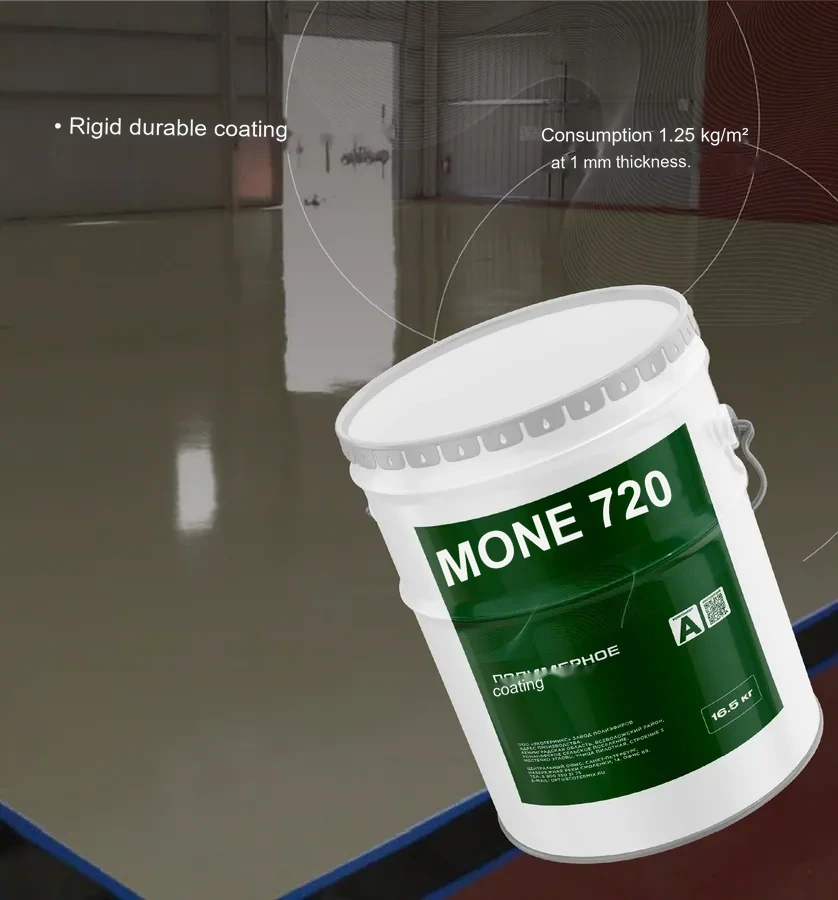
Polyurethane self-levelling floor MONE 720
Polyurethane self-levelling floor MONE 720 is a two-component, coloured polyurethane compound for creating polymer coatings.
Details →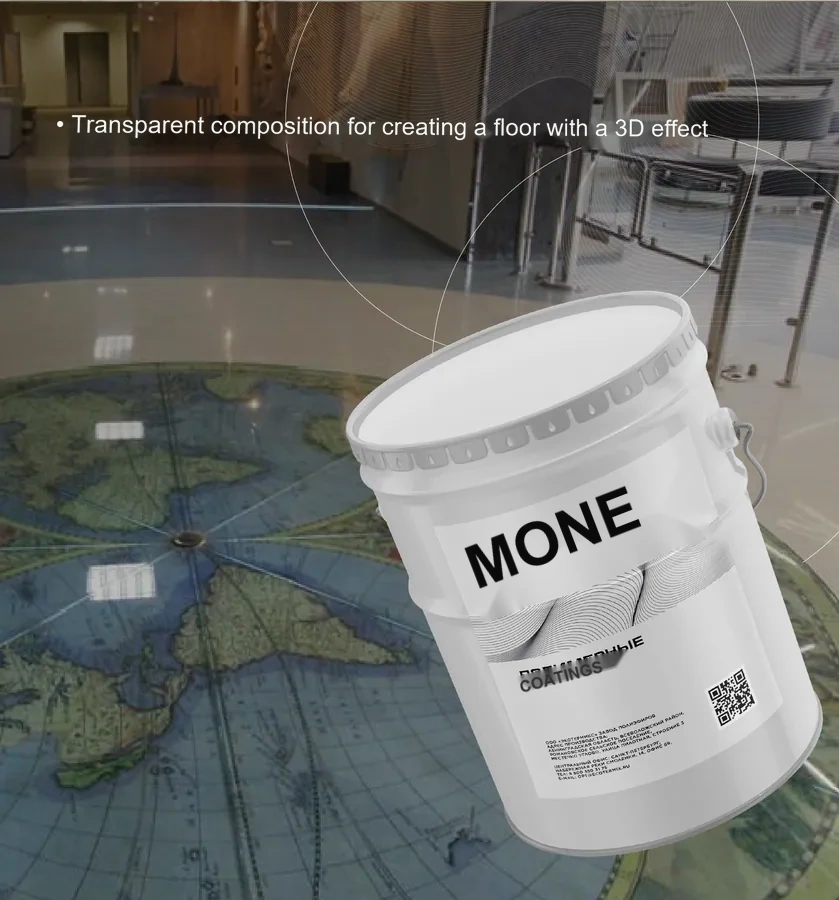
Transparent Epoxy Self-Levelling Floor MONE 823D
Epoxy compound for 3D floor installation MONE 823D
Details →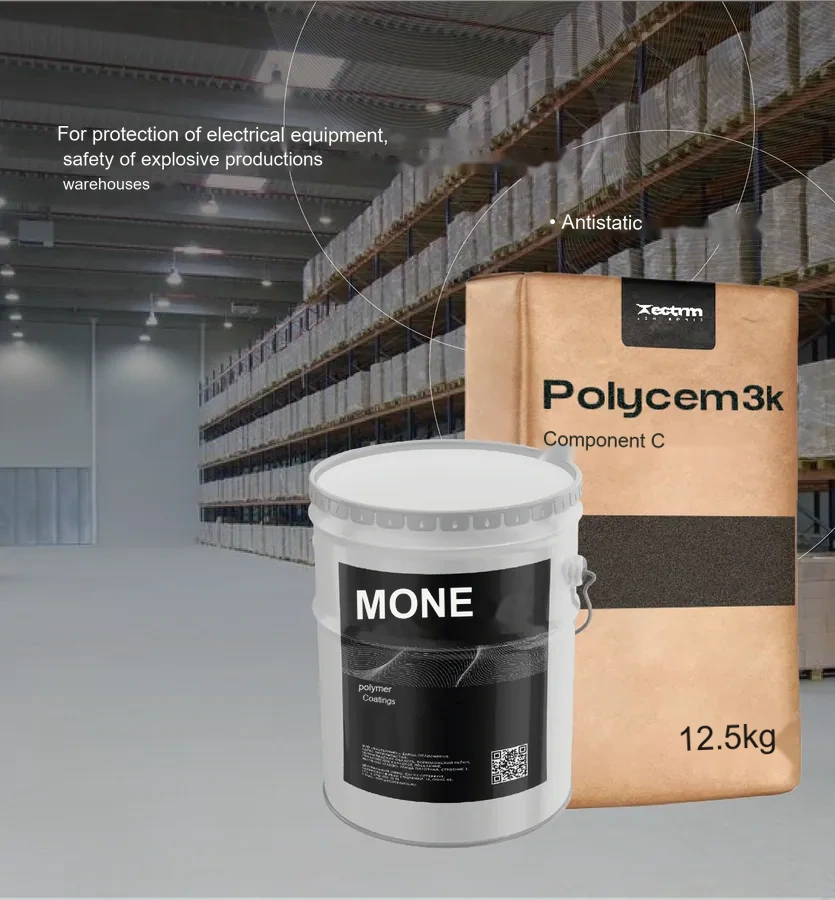
MONE Polycem 3K AS polyurethane-cement system
Polyurethane-cement system for medium and heavy-duty service conditions "MONE Polycem 3K AS".
Details →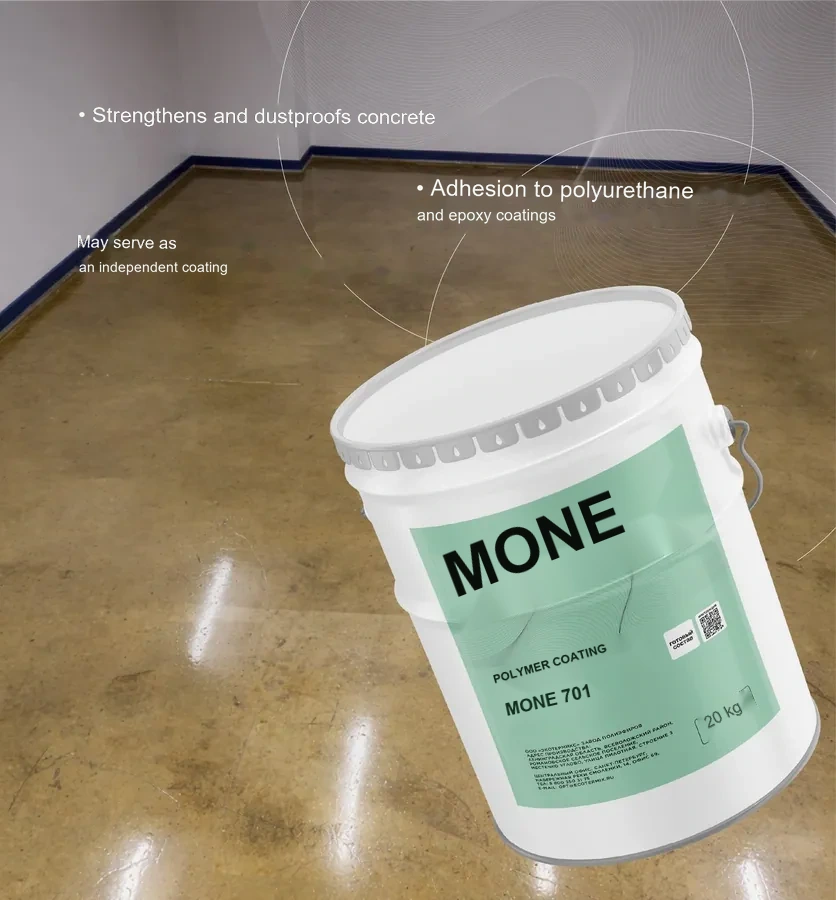
Polyurethane Primer MONE 701
Single-component polyurethane primer MONE 701 is applied to mineral and metal substrates, forming an adhesive layer. Cures by moisture in the air.
Details →Need a quote or technical advice?
Tell us about your application, volumes and destination. Our team will reply with a proposal and technical data sheets.