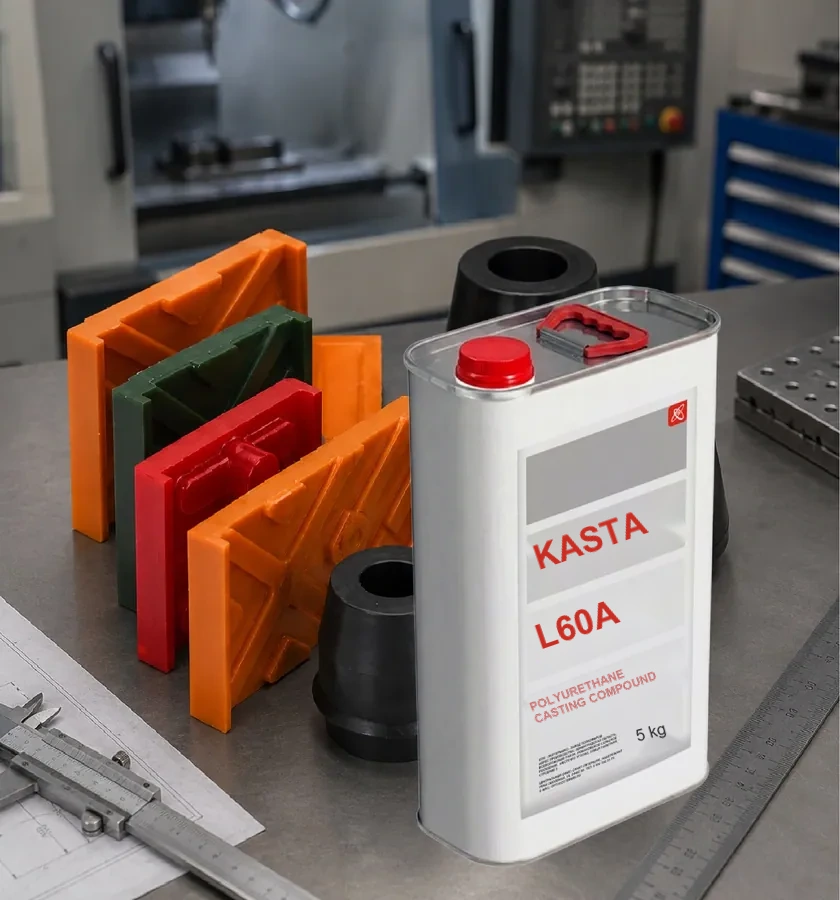
KASTA L60A Potting Compound
KASTA L60A is a two-component, cold-curing polyurethane system for producing flexible matrices and molds. The material is used for molds for artificial stone, gypsum and concrete products, architectural elements, decorative parts, casting metal rolls, and manufacturing parts for various purposes. In terms of its working profile, it is a liquid two-component polyurethane for molds with a mass mix ratio of components of 100:100 and a cured elastomer hardness of 60 ± 5 Shore A. Selection takes into account component viscosity, pot life of the mix, mold moisture, processing temperature, and the time before the product can be put into service.
| Pot life, min | 20 ± 5 |
| Post-curing time, h | 1 |
| Time to service, days | 3 |
| Shore A hardness, units | 60 ± 5 |
Description
KASTA L60A is used as a polyurethane potting compound for mold making when a flexible matrix with a hardness of 60 ± 5 Shore A is required. Component A is a blend of polyester polyols with functional additives, while component B is a polyurethane prepolymer. After mixing, the components cure at room temperature to form an elastomer.
The mass mix ratio of the components is 100:100. For a 4.0 kg batch of ready mix, 2.0 kg of each component is required. The permissible deviation must not exceed 5%: for a 2.0 kg charge, this is no more than 0.10 kg. Dosing is carried out by weight.
A pot life of 20 ± 5 minutes sets the working window of the mix. Before mixing begins, prepare the mold, release agent, containers, scales, mixer, and the pouring route. The components are mixed for 1–2 minutes until homogeneous, running the mixer along the walls and bottom of the container.
For stable processing, the air temperature must be no lower than +10 °C, the substrate or mold temperature must be from +15 to +20 °C, substrate moisture must not exceed 3%, and relative air humidity must be 60–75%. Condensation and any contact of the components with moisture are not permitted.
Polyurethane for casting molds of this type is selected based on a combination of parameters: Shore A hardness, component viscosity, pot life of the mix, curing regime, moisture requirements, and part geometry. The standard curing regime takes place at +20…+25 °C, demolding is carried out after 24 hours, and full properties develop over 48–72 hours.
Characteristics
|
Parameter |
Component A |
Component B |
Conditions or method |
|
Dynamic viscosity |
1500–3000 mPa·s |
2000–4000 mPa·s |
25 °C; GOST 25271-93 / ASTM D 4889 |
|
Density |
1.0 ± 0.2 g/cm³ |
1.1 ± 0.2 g/cm³ |
25 °C; GOST 18995.1-73 / ASTM D 891 |
|
Shelf life |
6 months |
6 months |
In tightly sealed packaging |
Processing parameters
|
Parameter |
Value |
Comment |
|
Mass mix ratio |
100:100 |
Permissible deviation — no more than 5% |
|
Pot life of the mix |
10–20 minutes |
Under recommended processing conditions |
|
Post-curing time |
24 hours |
After pouring and initial setting in the mold |
|
Demolding |
After 24 hours |
At the standard regime of +20…+25 °C |
|
Full properties development |
48–72 hours |
Under standard curing regime |
|
Time to service |
3 days |
Before working loads |
|
Hardness |
60 ± 5 Shore A |
For the cured material |
|
Mixing |
1–2 minutes |
Until homogeneous; pay particular attention to the walls and bottom of the container |
|
Equipment |
Mixer at no more than 300 rpm |
Low-speed mixing |
Processing conditions
|
Parameter |
Requirement |
|
Air temperature |
Not below +10 °C |
|
Substrate or mold temperature |
From +15 to +20 °C; in winter +18…+20 °C |
|
Substrate moisture |
Not more than 3% |
|
Relative air humidity |
60–75% |
|
Moisture condensation |
Not permitted |
|
Critical limitation |
Any contact of the components with moisture is not permitted |
|
Mold |
Open or closed molds are allowed |
|
Release agent |
Treating the mold surface is recommended |
Storage conditions
The components are stored at +10…+25 °C in tightly sealed packaging with mandatory protection from moisture. Freezing and damage to the packaging should be avoided. The shelf life is 6 months from the date of manufacture.
If component A crystallizes at temperatures below +15 °C, it is heated to +40…+60 °C without an open flame and held until fully de-crystallized. After mixing, the component is held to degas and then cooled to +20…+25 °C.
Transportation must prevent water ingress, packaging damage, and freezing. After the shelf life has expired, the product may only be used after verification of compliance with the technical documentation.
|
Parameter |
Value |
|
Storage temperature |
From +10 to +25 °C |
|
Shelf life |
6 months |
|
Packaging |
Tightly sealed |
|
Protection |
From moisture, condensation, and freezing |
|
Preparation of component A in case of crystallization |
Heating to +40…+60 °C without an open flame |
|
Working temperature after preparation |
+20…+25 °C |
Analogues
Market analogues of KASTA L60A include two-component liquid polyurethane mold rubbers with a hardness of around 60 Shore A. They should not be regarded as automatic substitutes without comparing technical documentation and conducting a trial pour: viscosity, pot life, curing regime, shrinkage, mold durability, and release agent requirements all differ.
For initial comparison, Tixaflex 60, VytaFlex 60, Lastor 7760, Caspol Alt, F-Mold 60, Silagerm 6060P, and Smooth-On PMC 746 can be considered. These materials belong to the class of two-component polyurethane rubbers with a hardness of 60 Shore A; however, suitability should be confirmed against their own TDS and the conditions of a specific production process.
|
What to compare |
Why it matters |
|
Shore A hardness |
Determines mold flexibility and the demolding force required for part removal |
|
Viscosity of components and mix |
Affects fill of relief detail and the risk of incomplete mixing |
|
Mix ratio of components |
Determines dosing requirements |
|
Pot life of the mix |
Sets the time available for mixing, degassing, and pouring |
|
Curing time |
Affects the production cycle |
|
Moisture conditions |
Water and condensation are critical for polyurethanes |
|
TDS, SDS, and quality certificate |
Confirm the material's suitability and limitations |
Related products
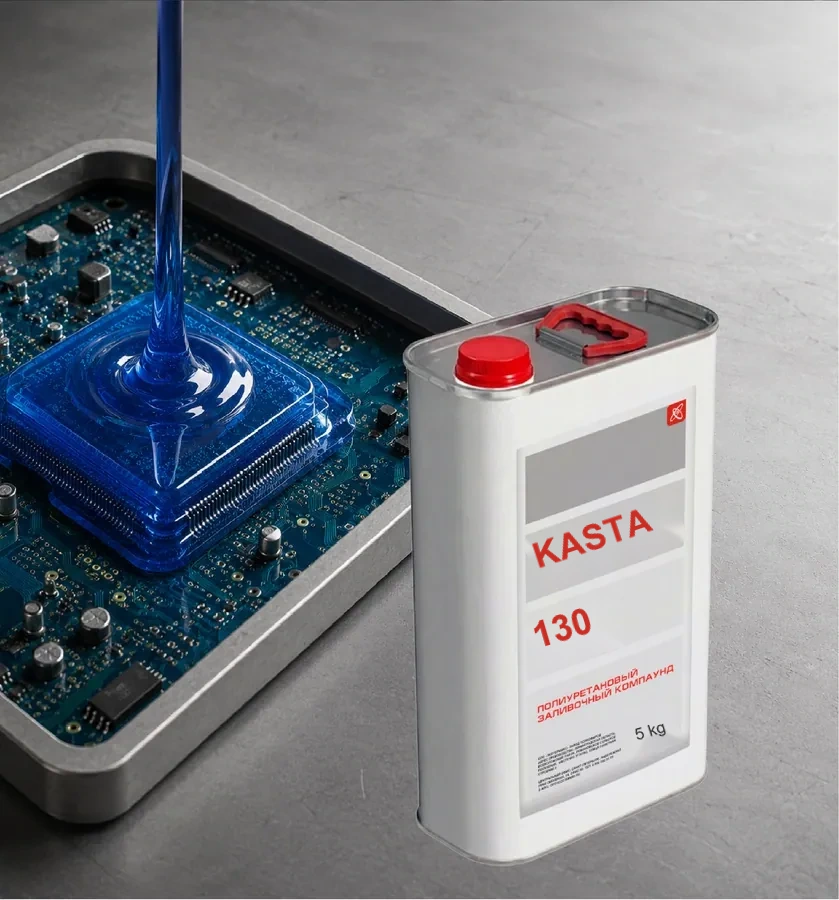
KASTA 130 Compound
Type: polyurethane Shore D hardness, units: 75 ± 3 Pot life, min: 30 ± 5 min Time to service, days: 2
Details →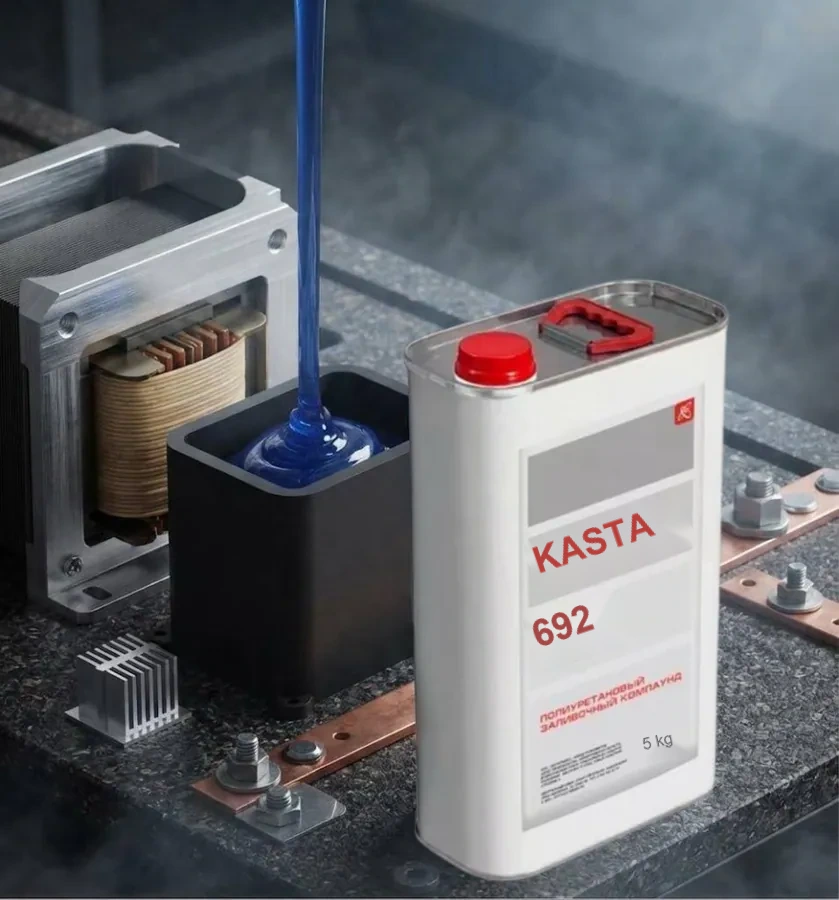
Potting Compound KASTA 692
Type: thermally conductive polyurethane Shore A hardness, units: 85±5 Pot life, min: 10–50 Time to service, days: 2
Details →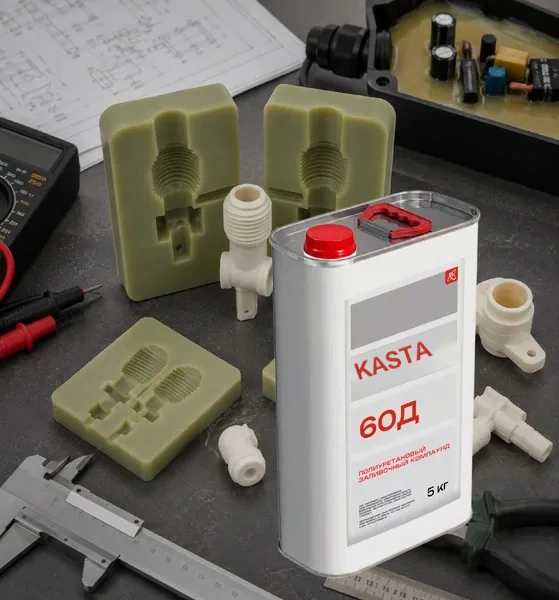
KASTA 60D Potting Compound
Type: polyurethane Shore D hardness, units: 60±5 Pot life, min: 10±5 Time to service, days: 3
Details →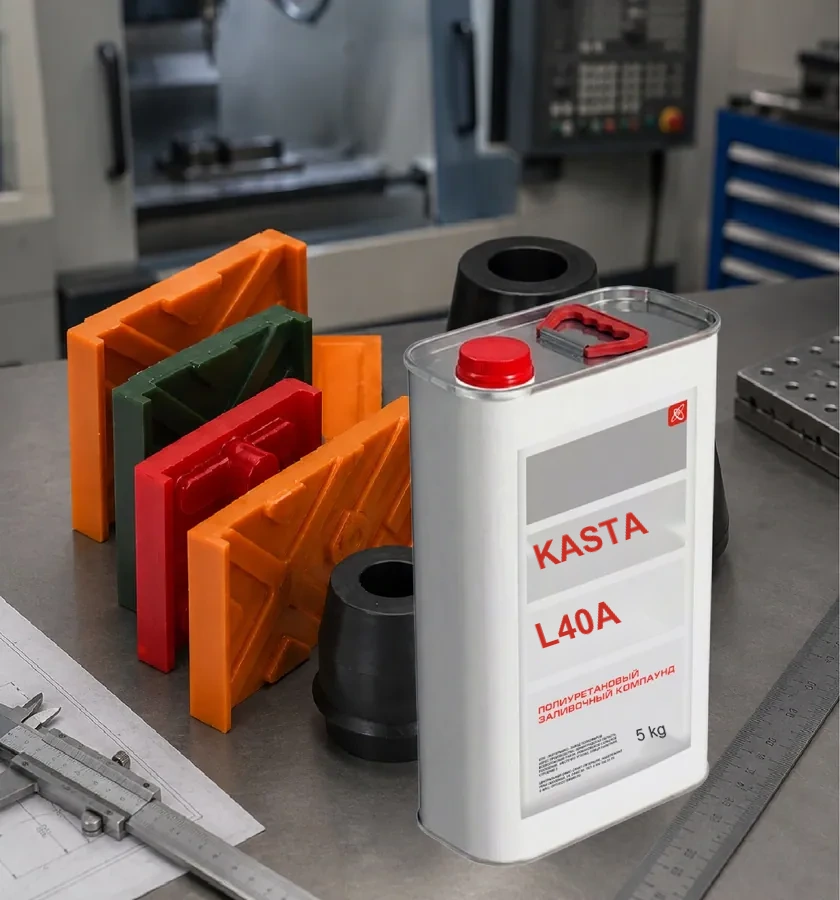
KASTA L40A Potting Compound
Type: polyurethane Shore A hardness, units: 40±5 Pot life, min: 15±5 Time to service, days: 3
Details →Need a quote or technical advice?
Tell us about your application, volumes and destination. Our team will reply with a proposal and technical data sheets.