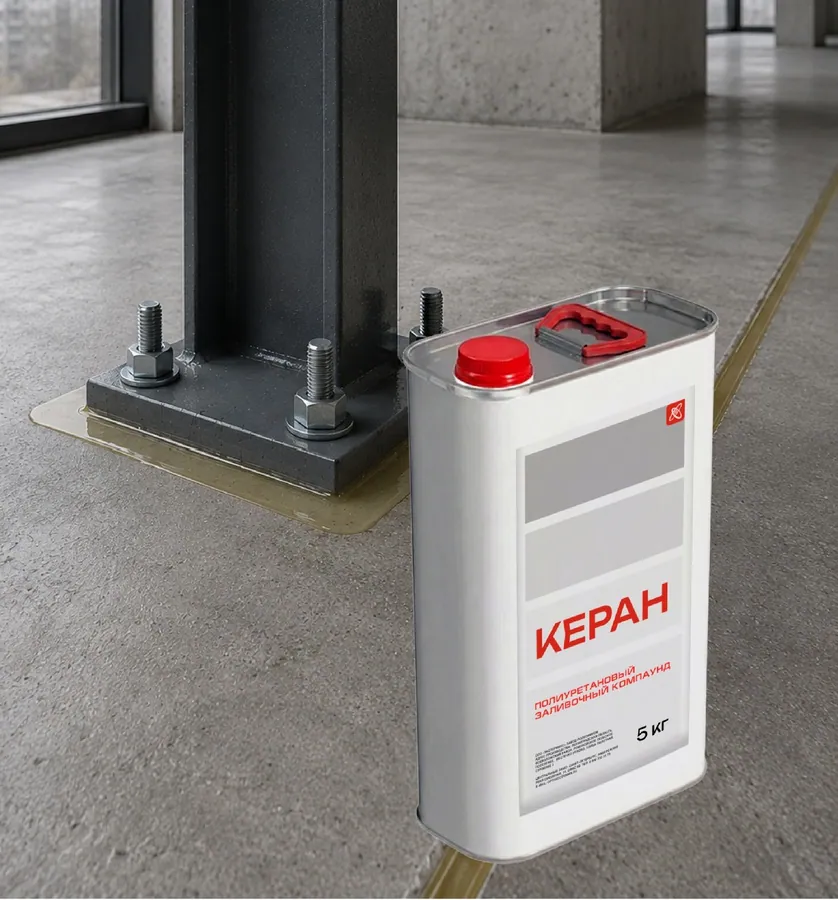
Keran Epoxy Anchor
Keran is a two-component epoxy anchoring compound for high-strength fastening of metal elements in concrete, stone and brick substrates. The material is used for anchoring threaded rods and rebar dowels, installing metal structures and engineering equipment, fixing embedded parts, as well as strengthening and repairing building structures.
Request a quoteDescription
Keran is designed for adhesive anchor connections in dense mineral substrates. The thixotropic consistency of both components helps keep the compound in the installation zone, while the cured epoxy system forms a rigid bond between the metal fastener and the substrate.
The material is used for:
- anchoring threaded rods;
- installing rebar dowels;
- fastening metal structures;
- installing engineering equipment;
- fixing embedded parts;
- strengthening and repairing building structures;
- fastening railings, handrails and support elements.
The working mass mix ratio of the components is 100:46.
To calculate the amount of component B, use the formula:
- mB = mA × 0.46
For example, 10 kg of component A requires 4.6 kg of component B; the total mixture weight will be 14.6 kg. The permissible deviation from the set ratio is no more than 5%, however for reproducible results the components should be dosed as precisely as possible.
|
Parameter |
Value |
|
Type |
Two-component epoxy anchoring compound |
|
Purpose |
Fastening metal elements in mineral substrates |
|
Suitable substrates |
Concrete, reinforced concrete, solid brick, natural and artificial stone, dense building blocks |
|
Mix ratio A:B |
100:46 by weight |
|
Pot life |
15–25 minutes |
|
Post-cure time |
10 ± 5 hours |
|
Time to service load |
24 hours |
|
Hardness |
80 ± 5 Shore D |
|
Solids content |
100% for both components |
Scope of application
Keran is suitable for concrete, reinforced concrete, solid brick, natural and artificial stone and dense building blocks. Applicability to hollow, cellular, wet or cracked substrates, as well as the calculated load-bearing capacity of the connection, must be confirmed by design calculation and testing.
When selecting the system, consider the substrate material and condition, the diameter and installation depth of the fastener, the design load, edge distance, spacing between anchors, and service conditions. The parameters stated in the technical data sheet do not replace the anchor connection calculation.
Specifications
Physical properties of the components
|
Parameter |
Component A |
Component B |
Method |
|
Dynamic viscosity |
Thixotropic paste |
Thixotropic paste |
Visual |
|
Density at 25 °C, g/cm³ |
1.3–1.5 |
1.1–1.25 |
GOST 31992.1 / ASTM D 891 |
|
Solids content, % |
100 |
100 |
Visual |
Reaction and properties of the cured material
|
Parameter |
Value |
|
Mix ratio A:B |
100:46 by weight |
|
Permissible deviation from the ratio |
No more than 5% |
|
Pot life |
15–25 minutes |
|
Post-cure time |
10 ± 5 hours |
|
Time to service load |
24 hours |
|
Shore D hardness |
80 ± 5 |
The values given are indicative and depend on temperature, humidity, dosing accuracy, mixing quality, layer thickness and curing conditions. For critical connections, preliminary testing in the actual substrate is required.
Storage conditions
Keran should be stored at +5…+30 °C in tightly sealed containers, protected from moisture. Freezing is not permitted. Shelf life is 12 months from the date of manufacture.
During transportation, containers must be protected from damage, precipitation and sub-zero temperatures. Material with an expired shelf life may only be used after verification of compliance with the technical documentation requirements.
Processing conditions
|
Parameter |
Requirement |
|
Air temperature |
Not below +10 °C |
|
Substrate temperature |
+15…+20 °C |
|
Substrate moisture |
No more than 3% |
|
Relative air humidity |
60–75% |
To achieve the stated properties, the approved process instructions and manufacturer's recommendations must be followed. The substrate and fastener must be prepared in accordance with the design and installation method.
Application procedure
- Check the substrate type, strength and condition, and confirm that the selected fastener matches the design load.
- Prepare a hole of the required diameter and depth.
- Remove drilling dust and contamination from the hole using the method specified in the process instructions.
- Ensure that the substrate moisture does not exceed 3% and the substrate temperature is within the +15…+20 °C range.
- Prepare clean, dry containers and tools.
- Weigh the components in a mass ratio of 100:46.
- Mix the compound thoroughly until homogeneous and use it within the 15–25 minute pot life.
- Fill the prepared area with the compound without forming voids.
- Install the fastener in the design position and hold it in place during curing.
- Do not load the connection until 24 hours have elapsed.
The exact requirements for hole cleaning, anchorage depth, consumption, hold time at other temperatures and permissible load are determined by the design, process instructions and test results.
Tools must be cleaned before the material cures. Remove coarse residues mechanically, then use a compatible solvent in accordance with its safety data sheet and ventilation requirements.
Equivalent products
Comparable products include two-component epoxy chemical anchors and injectable adhesive compounds for installing threaded rods and rebar in mineral substrates. This does not imply direct interchangeability: products may differ in viscosity, component ratio, pot life, temperature range, substrate tolerances and confirmed load-bearing capacity.
For an initial comparison, Hilti HIT-RE 500 V4, Fischer FIS EM Plus, Mungo MIT 600 RE, Sormat ITH Epox and Mapei Mapefix EP 385 can be considered. These materials belong to the chemical anchor class, however suitability must be confirmed against their own TDS and the conditions of the specific project.
Before substitution, compare:
- permissible substrates and concrete condition;
- design load, anchorage diameter and depth;
- pot life, curing time and time to load;
- temperature and humidity limitations;
- system composition and dosing method;
- availability of test reports and design approvals.
Equivalence should be confirmed only after comparing the technical documentation, calculation and testing in the actual substrate.
Need a quote or technical advice?
Tell us about your application, volumes and destination. Our team will reply with a proposal and technical data sheets.