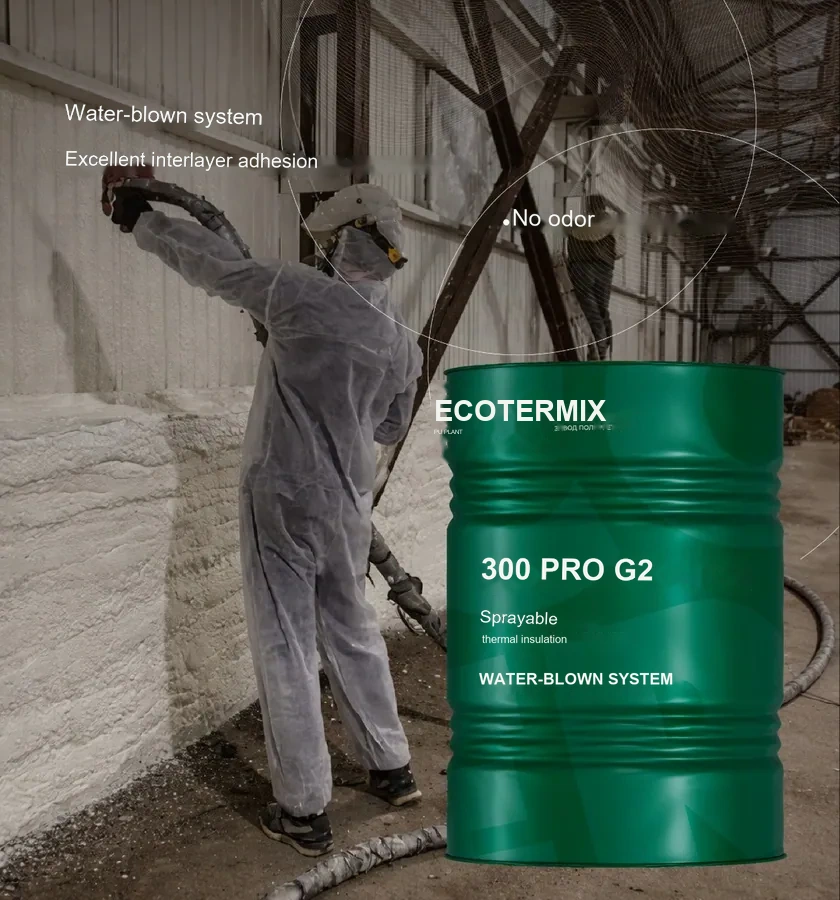
Ecotermix 300 (30) PRO G2
Ecotermix ETM 300 (30) PRO G2 is a professional two-component system for producing rigid closed-cell polyurethane foam by spray application.
| System weight, kg | 470 |
| Yield per set, m³ | 10 – 12 |
| Apparent density, kg/m³ | 25 – 35 |
| Application temperature, °C | from + 10 |
| Mix ratio A:B (by volume) | 100:100 |
Description
Ecotermix ETM 300 (30) PRO G2 is a professional two-component system for spraying rigid polyurethane foam, manufactured by Ecotermix, a Russian producer. When components A and B are mixed, a closed-cell PU foam with a fine-cell structure is formed, which instantly fills any irregularities of the substrate and creates a seamless thermal insulation coating without cold bridges. The thermal conductivity of the cured material is only 0.028–0.032 W/m·K — one of the best values among available insulation materials.
The system is used for thermal insulation of roofs, facades, floor slabs, walls, cold storage and warehouse facilities, as well as tanks and industrial equipment. Flammability class G2 makes the material suitable for use on facilities with increased fire safety requirements. It is applied by spraying using high- or low-pressure equipment, ensuring high installation speed and uniform coverage even on surfaces with complex geometry.
Features and benefits of ETM 300 (30) PRO G2
- Seamless coating without cold bridges
Spray PU foam fully follows the geometry of the surface, filling joints, cracks and corners. No additional fasteners or overlaps are needed — a single monolithic layer covers the entire plane.
- High thermal insulation performance
A thermal conductivity of 0.028–0.032 W/m·K provides effective energy savings with a minimal layer thickness, reducing building heat loss.
- Closed-cell structure
Minimal water absorption (2–5% over 24 h) and a built-in vapor barrier. The material does not accumulate moisture, does not rot, and does not lose its thermal insulation properties over time.
- Flammability class G2
Reduced flammability allows the system to be used on facilities with fire safety requirements: residential buildings, administrative buildings, warehouses and production facilities.
- Versatile application
Suitable for roofs, facades, floor slabs, floors, walls, cold rooms, tanks and process equipment of any shape.
- High application speed
Cream time is only 2–7 seconds, rise time is 8–18 seconds. Rapid strength build-up shortens installation time and allows the next layer to be applied after just 5–15 minutes.
- Compatibility with standard equipment
The system can be processed with high- and low-pressure SPF spraying equipment, without requiring specialized machinery.
- Long shelf life
12 months when storage conditions are observed (15–30 °C, sealed packaging) — convenient for bulk purchases and warehouse reserves.
Advantages over alternatives
Unlike mineral wool and expanded polystyrene, spray polyurethane foam does not require mechanical fastening, battens or cutting to size — it instantly fills all irregularities, joints and corners, forming a single monolithic layer. Compared to other PU foam systems on the market, ETM 300 (30) PRO G2 combines reduced flammability class G2, a record-low thermal conductivity, and universal equipment compatibility — making it an optimal choice for both private projects and industrial construction.
- No cold bridges or seams — the seamless coating eliminates heat loss at joints, typical of board and roll insulation materials.
- Insulation and vapor barrier in a single layer — no need for additional films or membranes, which reduces budget and installation time.
- Does not absorb moisture — water absorption of 2–5% over 24 h, the material does not rot or lose its properties when wet.
- Flammability class G2 — higher than most open-cell spray systems of class G3–G4.
- Works with any equipment — compatible with both high- and low-pressure units, without being tied to specific machinery.
- High installation speed — fast reaction and strength build-up allow the next layer to be applied after just 5–15 minutes.
How to buy ETM 300 (30) PRO G2
To check the current price and purchase the two-component spray polyurethane foam system, please submit a request on the website. Supplies are delivered in sets (component A + polymeric MDI) in an agreed ratio, which eliminates errors in proportioning during the work process. Special wholesale terms are available for contractors and companies with large volumes of thermal insulation work.
Specifications
Component ratio
| Name | Mass part | |
| Component A | ETM 300 (30) PRO G2 | 100 |
| Component B | Polymeric MDI (PMDI) | 105 |
Physical properties
| Units | Value | Method | |
| Dynamic viscosity | mPa·s | 300–800 (25°C) | GOST 1929-87, ASTM D 4889 |
| Density | kg/cm3 | 1000–1250 (25°C) | GOST 18995.1-73, ASTM D 891 |
| Shelf life | months | 12 |
Reaction characteristics under recommended conditions*
| Value | |
| Appearance | Liquid, white to yellow in color; separation is acceptable |
| Cream time, s | 2 – 7 |
| Rise time, s | 8 – 18 |
| Apparent density under free rise, kg/m³ | 24 – 35⁴ |
| Appearance of cured polyurethane foam and structure on vertical cross-section (visual) | Rigid foamed material. Fine-cell structure with a small number of enlarged cells |
| Thermal conductivity, W/m·K | 0.028 – 0.032 |
| Water absorption (24 h), % | 2 – 5 |
| Flammability class | G2 |
*The data refers to tests performed in accordance with the manufacturer's documentation using a laboratory mixer. Component temperature – 25±0.5°C, mixer rotation speed – 2000 rpm. Mixing time – 5 s.
Shelf life
12 months from the date of manufacture when stored in sealed packaging. After the shelf life expires, the product may be used after verification of compliance with the requirements of this technical documentation.
Alternatives
Equivalents to the ETM 300 (30) PRO G2 spray polyurethane foam system include two-component PU foam systems from other manufacturers of similar flammability class G2 and density — for example, formulations based on rigid closed-cell spray polyurethane foam with a thermal conductivity in the range of 0.028–0.035 W/m·K. When choosing between materials, it is recommended to consult a technical specialist regarding processing conditions, equipment requirements, component availability, and compatibility with the specific site and substrate type.
Related products
Ecotermix 300 (20) PRO G3
Blowing agent: Water System weight, kg: 470 Yield per set, m³: 17 – 21 Flammability class: G3 Application temperature, °C: from +10 Apparent density,
Details →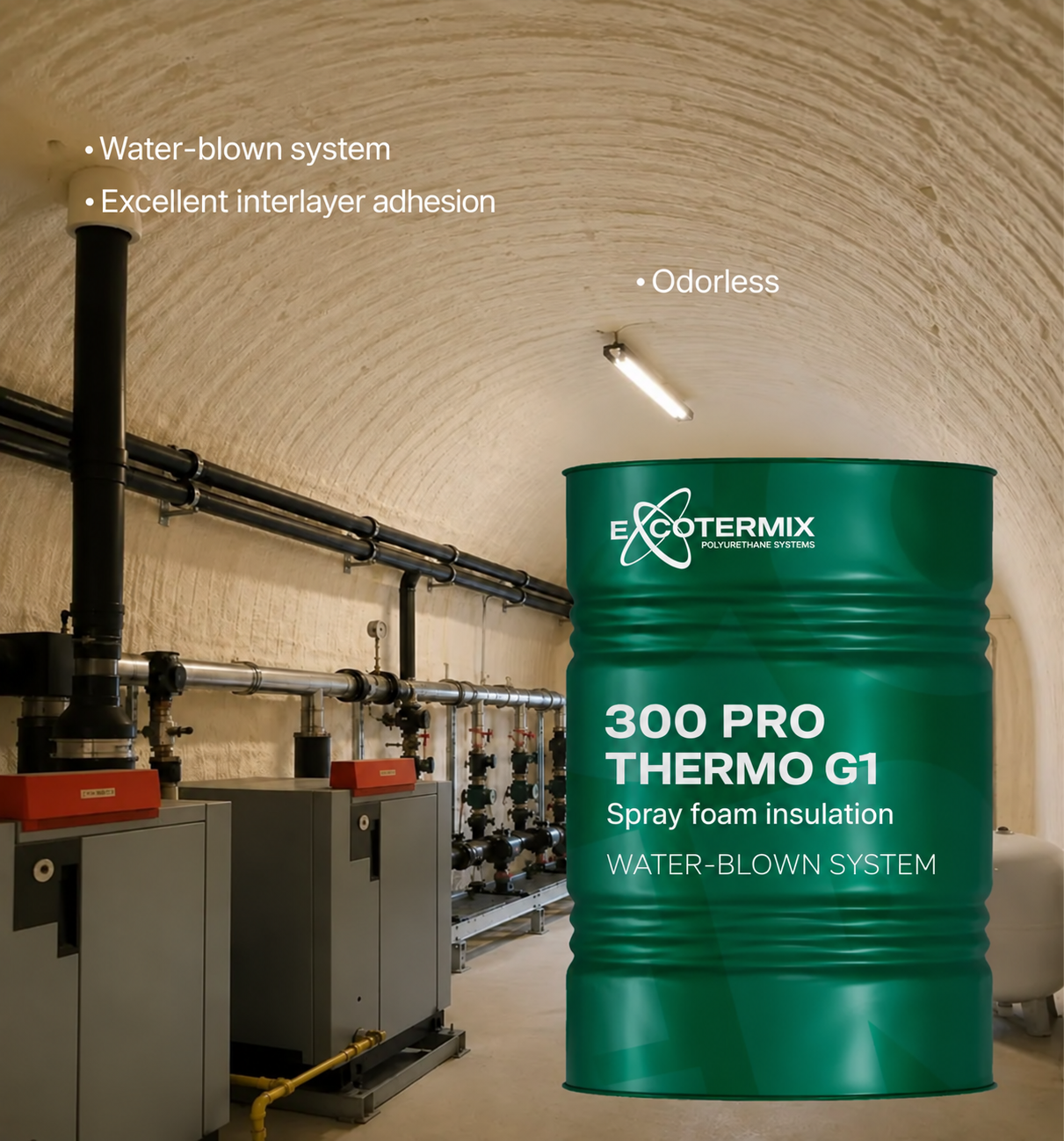
Ecotermix 300 (60) PRO THERMO G1
Blowing agent: Water System weight, kg: 470 Yield per set, m³: 6 – 6.5 Continuous operating temperature, °C: –60 to +150 Flammability class: G1 Appare
Details →Ecotermix 300 (40) PRO THERMO G1
Blowing agent: Water System weight, kg: 470 Yield per set, m³: 8.5–9.5 Continuous operating temperature, °C: –60 to +150 Flammability class: G1 Appare
Details →Ecotermix 300 (50) PRO THERMO G1
Blowing agent: Water System weight, kg: 470 Yield per set, m³: 7 – 7.5 Continuous service temperature, °C: –60 to +150 Flammability class: G1 Apparent
Details →Need a quote or technical advice?
Tell us about your application, volumes and destination. Our team will reply with a proposal and technical data sheets.