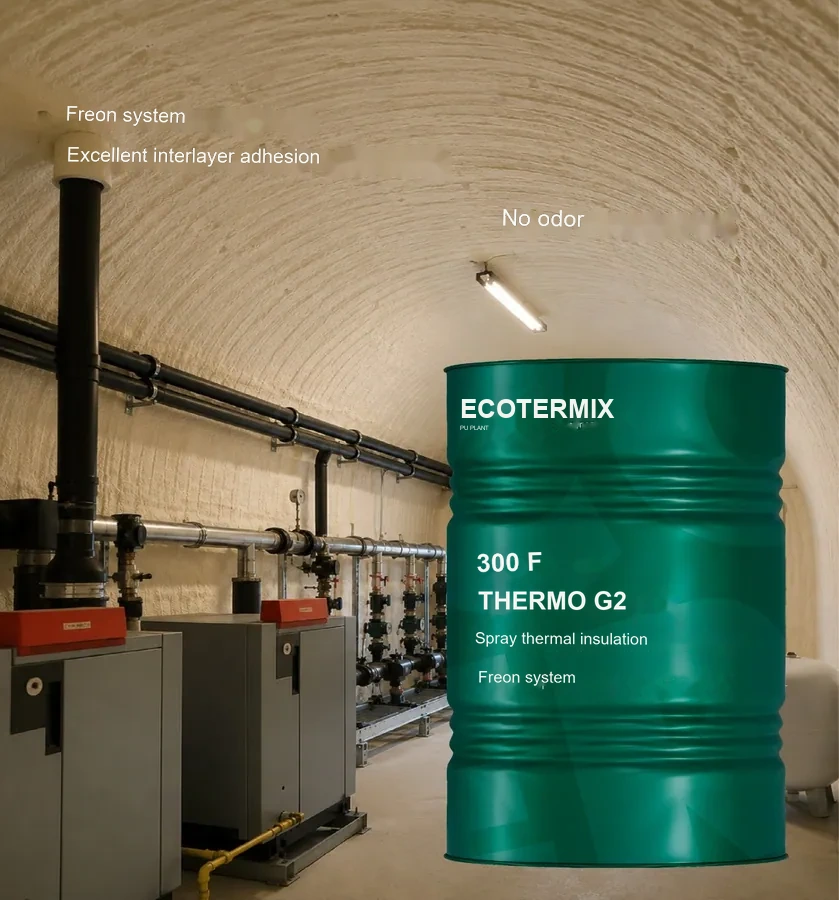
Ecotermix 300 (60) F THERMO G2
ETM 300 (60) F THERMO G2 is a two-component system for producing heat-resistant closed-cell spray polyurethane foam (SPF), designed for creating seamless thermal insulation of hot surfaces, industrial equipment and building structures. The material is rated for continuous operation at temperatures from –60 to +150 °C and withstands short-term exposure up to +180 °C. The system is used for thermal insulation of hot pipelines, tanks, heat exchangers, process equipment, boiler houses, utility networks, as well as for insulating buildings, hangars, roofs and metal structures.
| Blowing agent | Freon |
| System weight, kg | 470 |
| Yield per set, m³ | 6 – 6.5 |
| Apparent density, kg/m³ | 55 – 65 |
| Constant operating temperature, °C | –60 to +150 |
| Mix ratio A:B (by volume) | 100:100 |
Description
ETM 300 (60) F THERMO G2 is a two-component system for producing heat-resistant closed-cell spray polyurethane foam (SPF), designed for creating seamless thermal insulation of hot surfaces, industrial equipment and building structures. The material is engineered for continuous operation at temperatures from –60 to +150 °C and withstands short-term exposure to temperatures up to +180 °C, making it suitable for projects where conventional PU foam systems reach the limits of their performance.
The system is used for thermal insulation of hot pipelines, process tanks, reservoirs, heat exchangers, production equipment, boiler houses, utility networks, as well as for insulating buildings, hangars, roofs and other structures. Closed-cell spray polyurethane foam forms a seamless insulation layer with high adhesion to metal, concrete, brick, wood and most construction materials, reducing heat loss and preventing cold bridges.
Freon is used as the blowing agent, allowing PU foam spraying at ambient temperatures as low as –5 °C. This makes the system suitable for performing insulation work during colder periods without a significant loss of coating quality.
Features and benefits
• Heat-resistant polyurethane foam for high temperatures
The system is designed for applications operating at elevated temperatures. The continuous operating temperature is up to +150 °C, and the material can briefly withstand heating up to +180 °C without significant change in performance properties.
• Thermal insulation of hot pipelines and equipment
The material is used for insulating pipelines, tanks, heat exchangers, process equipment, utility systems and other objects where it is necessary to maintain the temperature of the working medium or reduce heat losses.
• Heat retention and reduced energy losses
Closed-cell heat-resistant PU foam reduces heat energy losses, helps maintain a stable process temperature, and lowers heating or equipment warming costs.
• Suitable for bathhouses and saunas
The system can be used for insulating bathhouses, saunas, ceilings, roofs and other structures, provided the temperature of the insulation layer itself does not exceed the material's allowable operating values. The seamless coating effectively retains heat inside the space and eliminates cold bridges.
• Spraying at sub-zero temperatures
The Freon-blown system allows insulation to be applied by spraying at ambient temperatures as low as –5 °C, extending the construction season.
• Monolithic seamless thermal insulation
After spraying, a single layer of closed-cell polyurethane foam is formed, eliminating joints and cold bridges and providing reliable insulation for structures of complex shape.
Advantages over equivalent products
- heat-resistant polyurethane foam with an operating temperature up to +150 °C;
- allows thermal insulation of hot pipelines and industrial equipment;
- suitable for maintaining the temperature of hot tanks and reservoirs;
- PU foam spraying is possible at ambient temperatures as low as –5 °C;
- high adhesion to most construction materials;
- low water absorption and closed-cell structure;
- seamless insulation without cold bridges;
- reduced heat losses and improved energy efficiency of facilities.
Specifications
Component Ratio
|
Name |
Parts by weight |
|
Component A — ETM 300 (60) F THERMO G2 |
100 |
|
Component B — Polymeric MDI (PMDI) |
105 |
Physical Properties of Components
|
Parameter |
Unit |
Value |
Method |
|
Dynamic viscosity |
mPa·s |
300–600 (25 °C) |
GOST 1929-87 / ASTM D4889 |
|
Density |
kg/m³ |
1000–1250 (25 °C) |
GOST 18995.1-73 / ASTM D891 |
|
Shelf life |
months |
12 |
— |
Reaction Characteristics under Recommended Conditions*
|
Parameter |
Value |
|
Appearance |
Liquid, white to yellow colour; slight separation is acceptable |
|
Cream time, s |
2–7 |
|
Rise time, s |
10–30 |
|
Apparent density at free rise, kg/m³ |
55–65 |
|
Appearance of cured PU foam |
Rigid foam material with a fine-cell structure |
|
Thermal conductivity, W/(m·K) |
≤ 0.03 |
|
Water absorption (24 h), % |
2–5 |
|
Flammability class |
G2 |
* Data refer to laboratory testing at a component temperature of 25±0.5 °C, a mixing speed of 2000 rpm and a mixing time of 5 s. Actual values depend on processing conditions.
Shelf Life
The shelf life of the ETM 300 (60) F THERMO G2 system is 12 months from the date of manufacture, provided the components are stored in sealed factory packaging under the recommended storage conditions. To preserve the working properties of the two-component spray polyurethane foam system, the material must be protected from moisture, direct sunlight and extreme temperatures.
After the stated shelf life has elapsed, the PU foam components do not necessarily lose their performance properties. The material may still be used after verifying compliance with the technical documentation requirements and confirming that the required physical and chemical properties are retained. Before use, it is recommended to carry out incoming inspection and a trial foaming test, especially if the system is intended for critical polyurethane foam spraying work or industrial thermal insulation.
Equivalents
Equivalents to the ETM 300 (60) F THERMO G2 spray polyurethane foam system include two-component PU foam systems from other manufacturers of a similar flammability class (G2) and density — for example, Elastospray 1612, Khimtrast SKN-60 and other closed-cell rigid spray polyurethane foam formulations with an operating temperature of up to +150 °C and a thermal conductivity in the range of 0.028–0.035 W/(m·K). When choosing between materials, it is recommended to check with a technical specialist regarding processing conditions, equipment requirements, component availability, and compatibility with the specific project and substrate type.
Related products
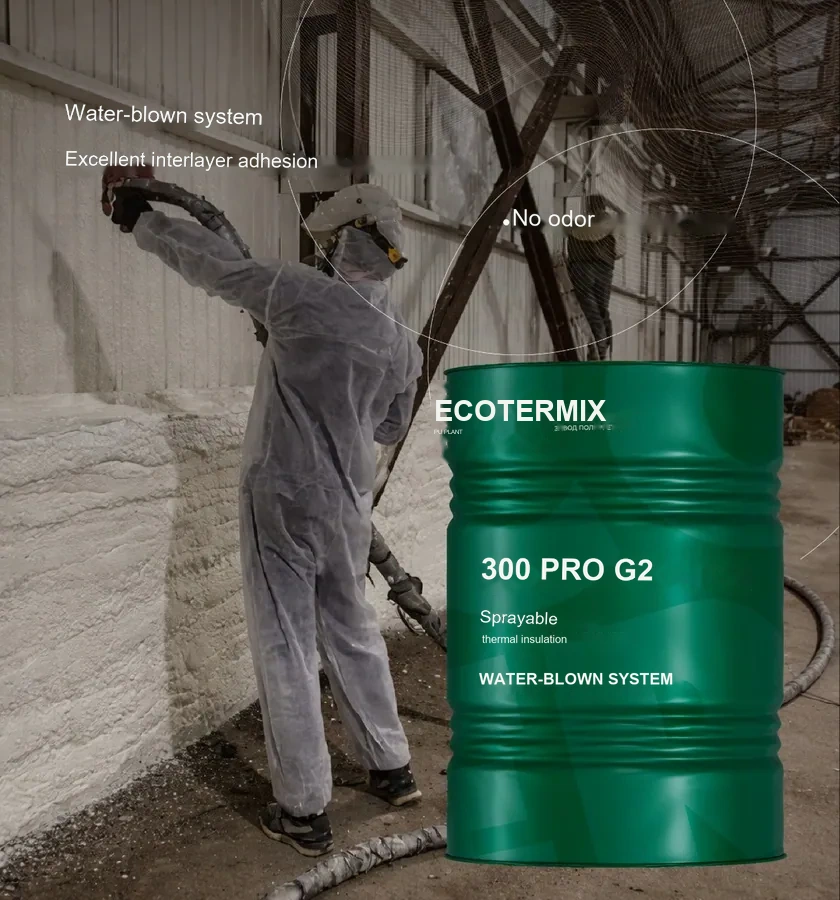
Ecotermix 300 (20) PRO G3
Blowing agent: Water System weight, kg: 470 Yield per set, m³: 17 – 21 Flammability class: G3 Application temperature, °C: from +10 Apparent density,
Details →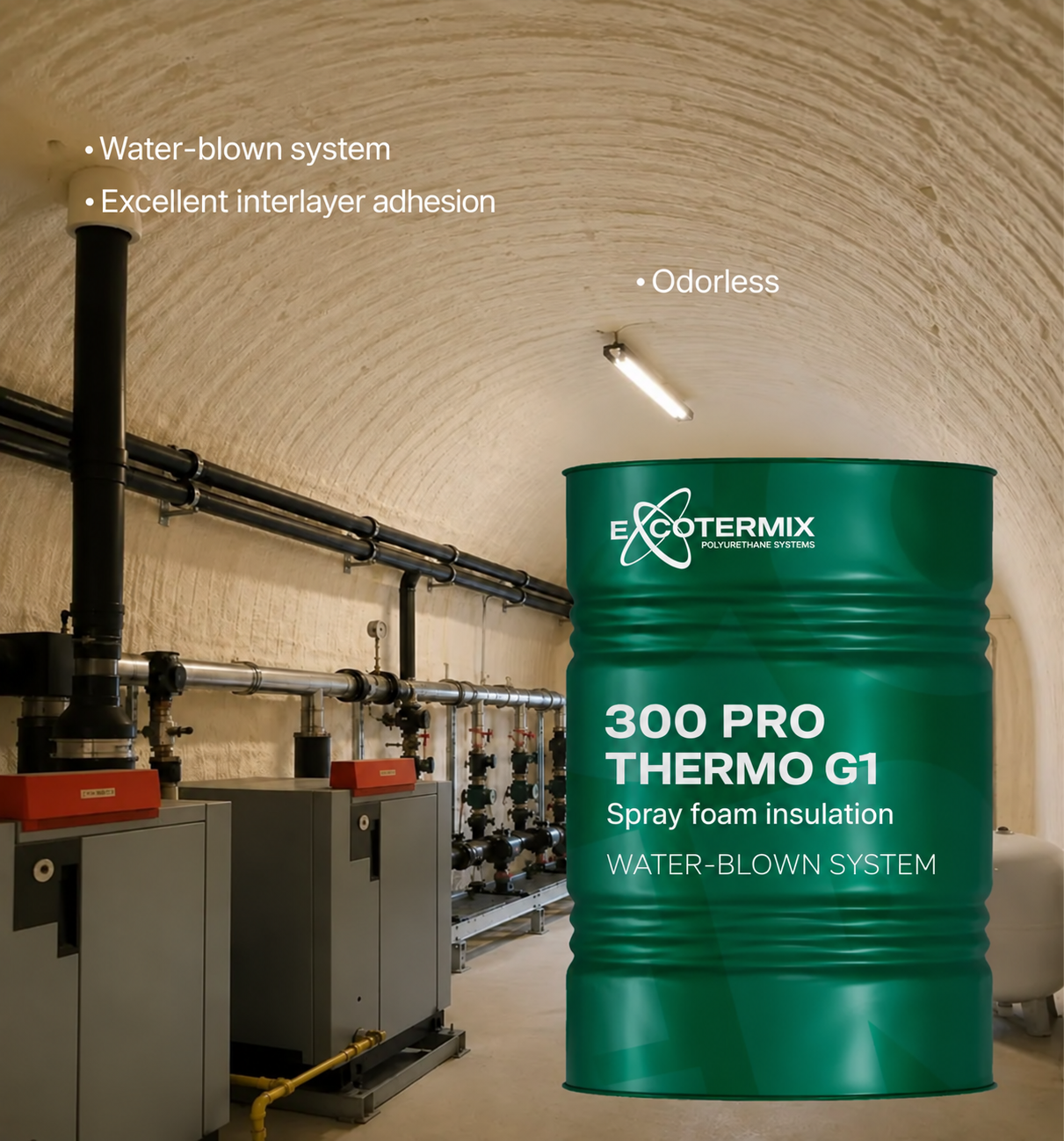
Ecotermix 300 (60) PRO THERMO G1
Blowing agent: Water System weight, kg: 470 Yield per set, m³: 6 – 6.5 Continuous operating temperature, °C: –60 to +150 Flammability class: G1 Appare
Details →Ecotermix 300 (40) PRO THERMO G1
Blowing agent: Water System weight, kg: 470 Yield per set, m³: 8.5–9.5 Continuous operating temperature, °C: –60 to +150 Flammability class: G1 Appare
Details →Ecotermix 300 (50) PRO THERMO G1
Blowing agent: Water System weight, kg: 470 Yield per set, m³: 7 – 7.5 Continuous service temperature, °C: –60 to +150 Flammability class: G1 Apparent
Details →Need a quote or technical advice?
Tell us about your application, volumes and destination. Our team will reply with a proposal and technical data sheets.