Ecotermix 300 (50) PRO G1
ETM 300 (50) PRO G1 is a two-component system for producing rigid thermal insulation polyurethane foam by spray application onto building structures.
| Blowing agent | Water |
| System weight, kg | 470 |
| Yield per set, m³ | 7 – 7.5 |
| Apparent density, kg/m³ | 45 – 55 |
| Application temperature, °C | from + 10 |
| Mix ratio A:B (by volume) | 100:100 |
Description
ETM 300 (50) PRO G1 is a two-component system for producing rigid thermal insulation polyurethane foam by spray application onto building structures. When component A (polyol) is mixed with component B (PMDI) in an SPF rig, a foaming chemical reaction takes place, forming a rigid closed-cell foam with a density of 50 kg/m³. The cured coating performs reliably across a temperature range from –40 °C to +300 °C, making the system a sought-after solution for thermal protection of steam and process pipelines, industrial equipment, tanks and metal structures. Flammability class G1 confirms the material's compliance with fire safety requirements for oil and gas, energy and industrial facilities.
The PRO series features a higher concentration of active components in the polyol blend, providing improved thermal insulation performance of the cured foam with lower system consumption on site. The closed-cell structure of the polyurethane foam ensures low thermal conductivity, high adhesion to metal, concrete and other substrates, as well as additional protection against corrosion and moisture ingress. The spray application method allows uniform coating of surfaces of any geometry - flanges, elbows, tees, weld seams - without cutting or fitting the material. The quality of the system is confirmed by testing to the international standards ASTM D 4889 and ASTM D 891.
Features and benefits of ETM 300 (50) PRO G1
ETM 300 (50) PRO G1 is not just a thermal insulation coating but a multifunctional, professional-grade protective coating.
- Extreme temperature range
An operating range from –40 °C to +300 °C covers the vast majority of industrial applications - from insulating cold storage rooms to steam pipelines and industrial furnaces. The coating does not crack, delaminate or lose adhesion under sharp temperature fluctuations. - Flammability class G1 - low-combustibility material
The formulation meets the fire safety requirements for industrial and civil facilities. Class G1 means the coating does not sustain combustion or spread fire, which is critical for oil and gas, energy and manufacturing facilities. - Thermal conductivity of 0.03 W/(m·K)
One of the best figures among liquid-applied thermal insulation coatings. This is achieved through a high content of microspheres with vacuumed air inside the formulation. Even 2-3 mm of coating delivers a noticeable insulating effect. - Vapour barrier and condensation protection
The coating has low vapour permeability, preventing condensation from forming on surfaces subject to temperature differentials. This is especially relevant for cold pipelines, ducts and structures in high-humidity environments. - Application to surfaces of any geometry
The liquid form allows seamless coating of flanges, elbows, tees, weld seams and other hard-to-reach components - areas where installing board or roll insulation materials is physically impossible or requires significant labour. - PRO series - enhanced formulation
Compared to the standard ETM range, the PRO series contains a higher concentration of thermal insulation components. This delivers a greater effect with fewer layers and reduces the total material consumption on site.
Advantages over alternatives
- Operating temperature up to +300 °C - most standard liquid-applied insulations are rated for +120–150 °C, and PU foam shells cannot withstand more than +110 °C. Ecotermix 300 (50) PRO G1 is suitable for hot steam and process pipelines without the need to change materials.
- Application to surfaces of any geometry - flanges, elbows, tees and weld seams are coated by brush or spray without the cutting and fitting required for mineral wool and PU foam shells.
- Flammability class G1 - low-combustibility - most competing liquid-applied products are class G2 or do not declare a fire classification at all. PU foam shells fall into class G3–G4.
- Built-in corrosion protection - the alkaline environment of the formulation (pH 12) passivates metal and prevents under-film corrosion. A separate anti-corrosion layer is required when using mineral wool or PU foam.
- High installation speed - application is completed in a single work shift without scaffolding, clamps or fasteners. Installing mineral wool mats and shells is significantly more labour-intensive.
- Simple maintenance and repair - damaged areas are restored with spot application by brush. Repairing board or roll materials requires dismantling entire sections.
- Minimal structural load - a coating thickness of 2–5 mm adds virtually no weight to the insulated object, unlike mineral wool mats and rigid shells.
- Work on live equipment - application is possible without stopping production. Installing rigid insulation in most cases requires taking equipment out of service.
- Compliance with international standards - the formulation is tested to ASTM D 4889 and ASTM D 891, which is important for projects with foreign technical supervision and international design documentation.
How to order ETM 300 (50) PRO G1
To check the current price and order the professional liquid thermal insulation system, please submit a request on the website. The product is supplied ready for use - the formulation is fully prepared for application and does not require mixing components on site, eliminating dosing errors during work. Special terms for bulk supply are available for contractors and companies handling large volumes of thermal insulation work.
Specifications
Component ratio
| Name | Mass part | |
| Component A | ETM 300 (50) PRO G2 | 100 |
| Component B | PMDI | 105 |
Physical properties
| Unit | Component | Method | |
| Dynamic viscosity | mPa·s | 300–800 (25°C) | GOST 1929-87, ASTM D 4889 |
| Density | kg/cm3 | 1000–1250 (25°C) | GOST 18995.1-73, ASTM D 891 |
| Shelf life | months | 12 |
Reaction characteristics under recommended conditions*
| Value | |
| Appearance | Liquid, white to yellow in colour; stratification is acceptable |
| Cream time, s | 2 – 7 |
| Rise time, s | 8 – 18 |
| Free-rise apparent density, kg/m³ | 45 – 55⁴ |
| Appearance of cured polyurethane foam and vertical cross-section structure (visual) | Rigid foam material. Fine-cell structure with a small number of enlarged cells |
| Thermal conductivity, W/m·K | ≤ 0.03 |
| Water absorption (24 h), % | 2 – 5 |
| Flammability class | G1 |
*The data relate to tests conducted in accordance with the manufacturer's documentation using a laboratory mixer. Component temperature - 25±0.5°C, mixer rotation speed - 2000 rpm. Mixing time 5 s.
Shelf life
12 months from the date of manufacture when stored in hermetically sealed containers. After the shelf life has expired, the product may be used following verification of compliance with the requirements of this technical documentation.
Alternatives
Equivalents to the «ETM 300 (50) PRO G1» spray polyurethane foam system include two-component SPF systems from other manufacturers with a similar flammability class G1 and density - for example, formulations based on closed-cell rigid polyurethane foam for spray application with an operating temperature of up to +300 °C and a thermal conductivity in the range of 0.028–0.035 W/m·K. When choosing between materials, it is recommended to consult a technical specialist regarding processing conditions, equipment requirements, component availability and compatibility with the specific site and substrate type.
Related products
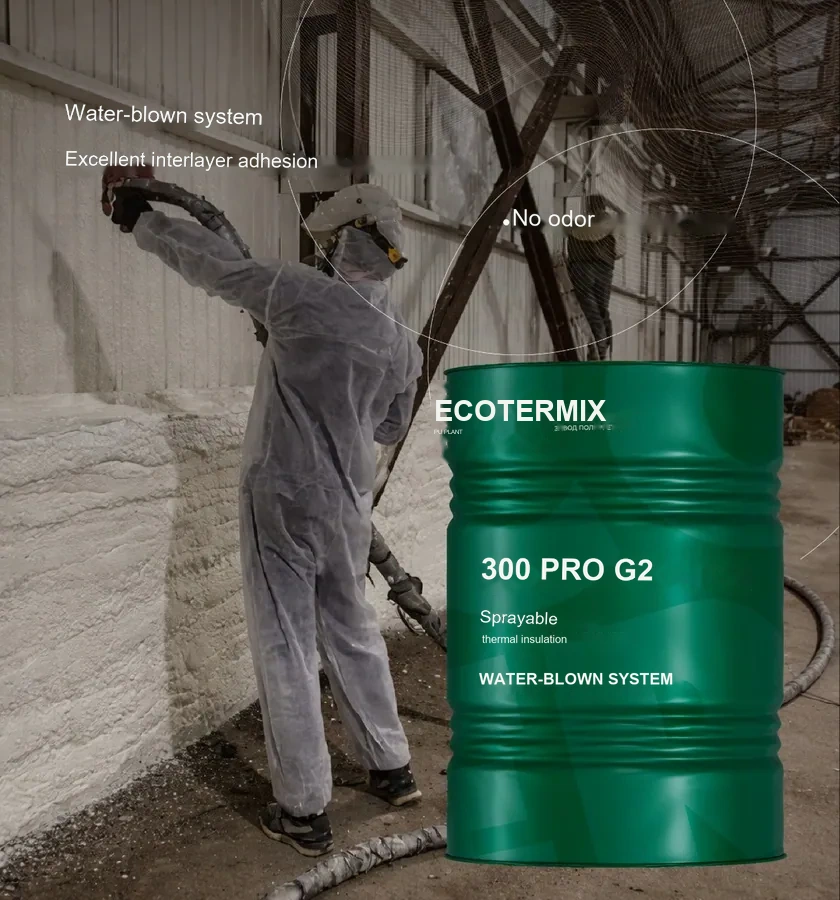
Ecotermix 300 (20) PRO G3
Blowing agent: Water System weight, kg: 470 Yield per set, m³: 17 – 21 Flammability class: G3 Application temperature, °C: from +10 Apparent density,
Details →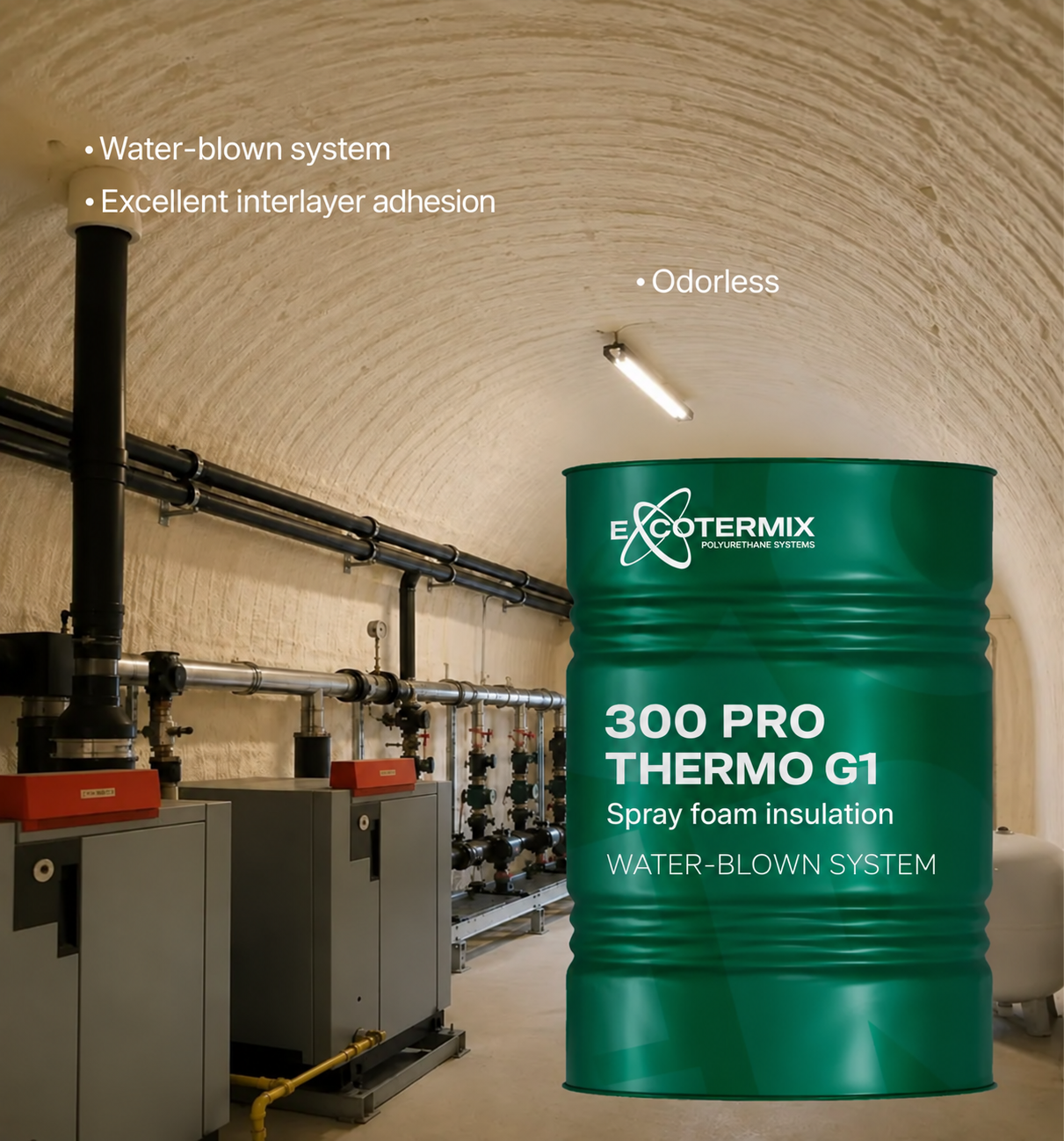
Ecotermix 300 (60) PRO THERMO G1
Blowing agent: Water System weight, kg: 470 Yield per set, m³: 6 – 6.5 Continuous operating temperature, °C: –60 to +150 Flammability class: G1 Appare
Details →Ecotermix 300 (40) PRO THERMO G1
Blowing agent: Water System weight, kg: 470 Yield per set, m³: 8.5–9.5 Continuous operating temperature, °C: –60 to +150 Flammability class: G1 Appare
Details →Ecotermix 300 (50) PRO THERMO G1
Blowing agent: Water System weight, kg: 470 Yield per set, m³: 7 – 7.5 Continuous service temperature, °C: –60 to +150 Flammability class: G1 Apparent
Details →Need a quote or technical advice?
Tell us about your application, volumes and destination. Our team will reply with a proposal and technical data sheets.