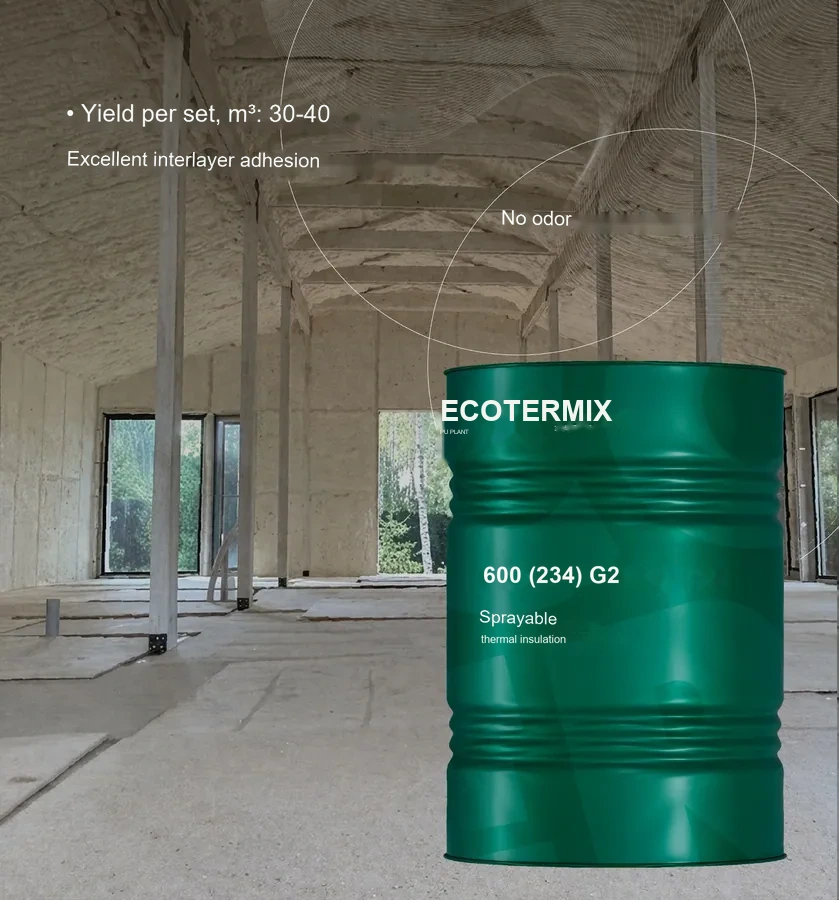
Ecotermix 600 (234) G2
A two-component, water-blown flammability class G2 system for spraying soft open-cell PU foam. Produces a seamless, vapor-permeable coating with a thermal conductivity of 0.036–0.040 W/m·K and a density from 7 kg/m³. Suitable for roofs, walls, floor/ceiling slabs, attics, and hard-to-reach cavities in building structures. The predominance of amine catalyst gives a characteristic odor during processing.
| Blowing agent | Water |
| System weight, kg | 7 – 7.5 |
| Yield per set, m³ | 30 – 40 |
| Apparent density, kg/m³ | 7 – 14 |
| Application temperature, °C | from +10 |
Description
ETM 600 (234) G2 is a professional two-component system for spraying polyurethane foam (PU foam), designed to provide effective thermal insulation in civil and industrial construction. The material forms a soft, open-cell polyurethane foam with a fine-cell structure, providing good vapor permeability, reliable adhesion, and uniform cavity filling.
The system is used for insulating roofs, attics, exterior and interior walls, inter-floor and attic floor slabs, as well as cavities in building structures and hard-to-reach areas. It is suitable both for new construction and for renovation projects requiring seamless thermal and acoustic insulation.
Features and benefits of ETM 600 (234) G2
ETM 600 (234) G2 is an environmentally friendly, water-blown spray polyurethane foam system developed for efficient insulation of building structures of various purposes. The material combines low density, ease of processing, and high energy efficiency without the use of freons.
- Environmentally friendly water-based blowing agent - free of freons and aggressive solvents.
- Thermal conductivity of 0.036–0.040 W/m·K, ensuring stable heat retention.
- Ultra-low apparent density in free rise - 7–14 kg/m³.
- Forms a seamless thermal insulation layer with no thermal bridges.
- Open, fine-cell structure with natural vapor permeability.
- Fast cream time (2–6 seconds) and rise time (8–15 seconds), speeding up application work.
- Low water absorption (2–5%) despite the open-cell structure.
- Flammability class G2 - moderately flammable material.
- Compatible with both high-pressure and low-pressure spray equipment.
- Effective filling of cavities and hard-to-reach areas without pressure buildup or shrinkage.
Thanks to these characteristics, the system is widely used in construction, enabling reliable, long-lasting thermal insulation with minimal environmental impact.
Advantages over alternatives
ETM 600 (234) G2 compares favorably to standard PU foam systems thanks to its eco-friendly formulation, ultra-low density, and ease of application under demanding site conditions. The material delivers a predictable result and uniform quality of the insulation layer.
- Water-based blowing agent - a safe alternative to freon-based systems without compromising insulation performance.
- Minimal material consumption thanks to the record-low foam density.
- Stable open-cell structure with an even distribution of fine cells.
- Fast system reaction, reducing application time.
- High adhesion to various substrates: concrete, metal, and wood.
- Minimized thermal bridging thanks to seamless application.
- Ideal for filling cavities, attic spaces, and structures with non-standard geometry.
- Versatile for use in both civil and industrial construction.
As a result, using ETM 600 (234) G2 improves the energy efficiency of a building, ensures natural air exchange through its vapor-permeable structure, and delivers a durable insulation solution with minimal operating costs.
How to order ETM 600 (234) G2
To check the current price and order the two-component ETM 600 (234) G2 spray polyurethane foam system, submit a request on the website or contact our sales team. The system is supplied in sets (component A + polymeric MDI) in a 100:105 ratio by weight, ensuring a stable reaction and consistent PU foam formation.
Special terms and favorable offers are available for contractors, construction companies, and businesses carrying out insulation work when purchasing in bulk.
Specifications
Component ratio
| Name | Parts by weight | |
| Component A | ETM 600 (234) G2 | 100 |
| Component B | Polymeric MDI (PMDI) | 105 |
Physical properties
| Unit | Component | Method | |
| Dynamic viscosity | mPa·s | 500–1000 (25°C) | GOST 1929-87, ASTM D 4889 |
| Density | kg/cm³ | 900–1100 (25°C) | GOST 18995.1-73, ASTM D 891 |
| Shelf life | months | 12 |
Reaction characteristics under recommended conditions*
| Value | |
| Appearance | Liquid, white to yellow in color, prone to separation |
| Cream time, s | 2 – 6 |
| Rise time, s | 8 – 15 |
| Apparent density in free rise, kg/m³ | 7 – 14 |
| Appearance of cured polyurethane foam and structure on vertical cross-section (visual) | Soft foamed material. Open, fine-cell structure with a small proportion of larger cells |
| Thermal conductivity, W/m·K | 0.036 – 0.040 |
| Water absorption (24 h), % | 2 – 5 |
| Flammability class | G2 |
*The data refer to tests performed in accordance with the manufacturer's documentation using a laboratory mixer. Component temperature – 25±0.5°C, mixer speed – 2000 rpm. Mixing time 5 s.
Shelf life
Storage conditions
- The components of the ETM 600 (234) G2 system must be stored in enclosed warehouse premises at a temperature between 15 °C and 30 °C, in tightly sealed containers that prevent the ingress of moisture, contamination, and direct sunlight.
Drums should be stored bung-up, at least 1 m away from heating appliances.
Warranty and shelf life
The shelf life of the system is 12 months from the date of manufacture, provided the storage conditions are observed. After the shelf life has expired, the product may still be used following verification of compliance with the requirements of the technical documentation.
Alternatives
In terms of performance, ETM 600 (234) G2 is comparable to light, water-blown, open-cell spray polyurethane foam systems from manufacturers such as Khimtrast, Izolan, Huntsman, and others. These materials are also used for seamless spray-applied thermal insulation and provide vapor permeability, good adhesion, and uniform filling of cavities in building structures.
At the same time, these systems may differ in foam density (for ETM 600 (234) G2 — 7–14 kg/m³ in free rise, corresponding to the light open-cell PU foam class), reaction time, flammability class (G2), as well as recommended processing temperature ranges and application conditions. The choice of a specific PU foam system depends on project requirements, insulation performance targets, operating conditions, and the equipment used.
Need a quote or technical advice?
Tell us about your application, volumes and destination. Our team will reply with a proposal and technical data sheets.