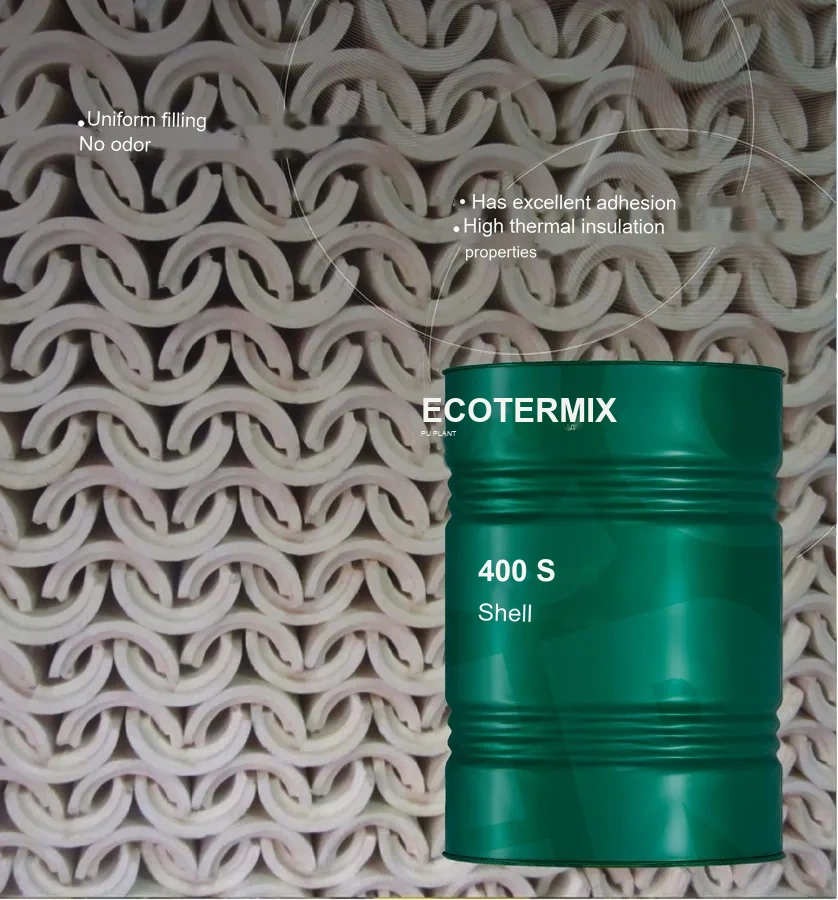
Ecotermix 400 S
Ecotermix 400 S PU foam component system for manufacturing thermal insulation shells (by pouring into moulds)
| Blowing agent | Water |
| Density in product | 28–35 kg/m3 |
| 200 kg |
Description
The Ecotermix 400 S system is used for manufacturing thermal insulation shells and other moulded products by pouring into moulds, through mixing of the polyol component (component A) and polymeric MDI (component B). The shells are rigid half-cylinders or segments of various lengths with longitudinal and transverse locking joints.
Specifications
Technical information for Ecotermix 400 S
The Ecotermix 400 S system is used for manufacturing thermal insulation shells and other moulded products by pouring into moulds, through mixing of the polyol component (component A) and polymeric MDI (component B).
System description
Component A
The Ecotermix 400 S polyol component (component A) is a ready-to-use polyol blend containing a mixture of polyether polyols and special additives.
Equivalent to grades Daltofoam TE® 32202 System, Daltofoam TE® 44262 System, IZOLAN®-210-4, IZOLAN®-242, IZOLAN®-213, IZOLAN®-224, IZOLAN®-214, IZOLAN®-221, IZOLAN® K-15, IZOLIT®-10, Elastopor H 2300/15, Elastopor H 2310/1.
Component B
Polymeric diphenylmethane diisocyanate of grades Wannate PM-200 (China), Voranate M229 (Netherlands), Cosmonate M-200 (Korea), Ongronate 2100 (Hungary), Lupranate M20S (Germany), Karoon KP-200 (Iran), Millionate MR-200 (Japan), Suprasec 5025 (5005)
| Free-rise density, kg/m3 | 30-35 |
| Density in product, kg/m3 | 60 |
| Hydroxyl number | 330-360 mg KOH/g |
| Thermal conductivity at average temperature of 500°C | 0.033 W/m·K |
| Compressive strength | 300 kPa |
| Water absorption over 24 hours, % max | 3% |
| Vicat heat resistance, min | 1500°C |
Processing guidelines
The Ecotermix 400 S system is processed by manual or machine pouring into closed metal moulds of various capacities and configurations.
Before pouring, the moulds are cleaned and coated with a release agent, which ensures easy and quick removal of the finished product.
When selecting a release agent, consider the PU system grade, the material the moulds are made of, the surface quality, and the geometric features of the moulds. Experimental optimisation is mandatory.
Optimal mould temperature is (20-22)°C.
Before processing, component A must be thoroughly mixed to a uniform consistency.
Components must be conditioned to a temperature of (20±2)°C before processing.
Mix ratio A:B (by weight) = 100 : 140
The holding time of the product in the mould depends on the product's configuration and dimensions and is determined experimentally.
After the holding time has elapsed, the product is removed from the mould and placed in a chamber at (20-30)°C for 24 hours, during which secondary curing processes of the polyurethane foam take place.
Processing should be carried out in accordance with the technical documentation for the equipment and the finished product manufacturing process.
Recommendations
Safety precautions
When working with the system, use a self-contained breathing apparatus, a gas mask with BKF or V filter cartridge, safety goggles with side shields, impermeable synthetic rubber gloves, and special clothing and footwear. Premises where work is carried out must be equipped with exhaust ventilation, and workstations with local extraction and fire-fighting equipment.
Storage recommendations
Shelf life of the polyol component is 6 months at 20°C in unopened drums.
Related products
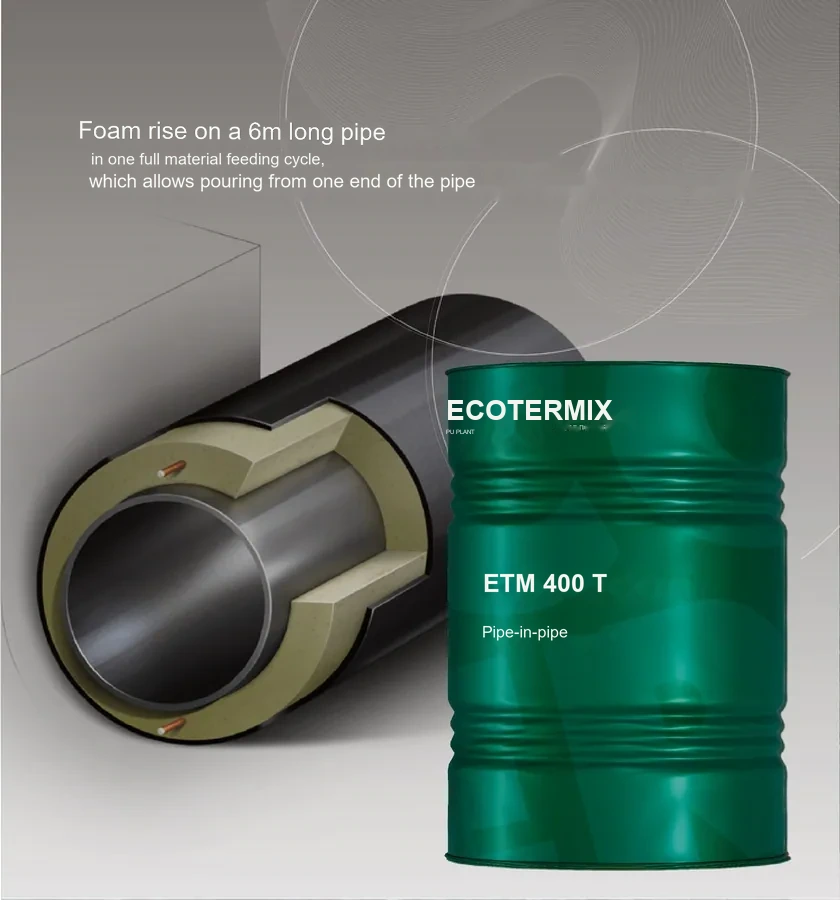
Ecotermix 400 T (100:140)
PU foam component system "Ecotermix 400 T (100:140)" for manufacturing thermal insulation pipes and joints
Details →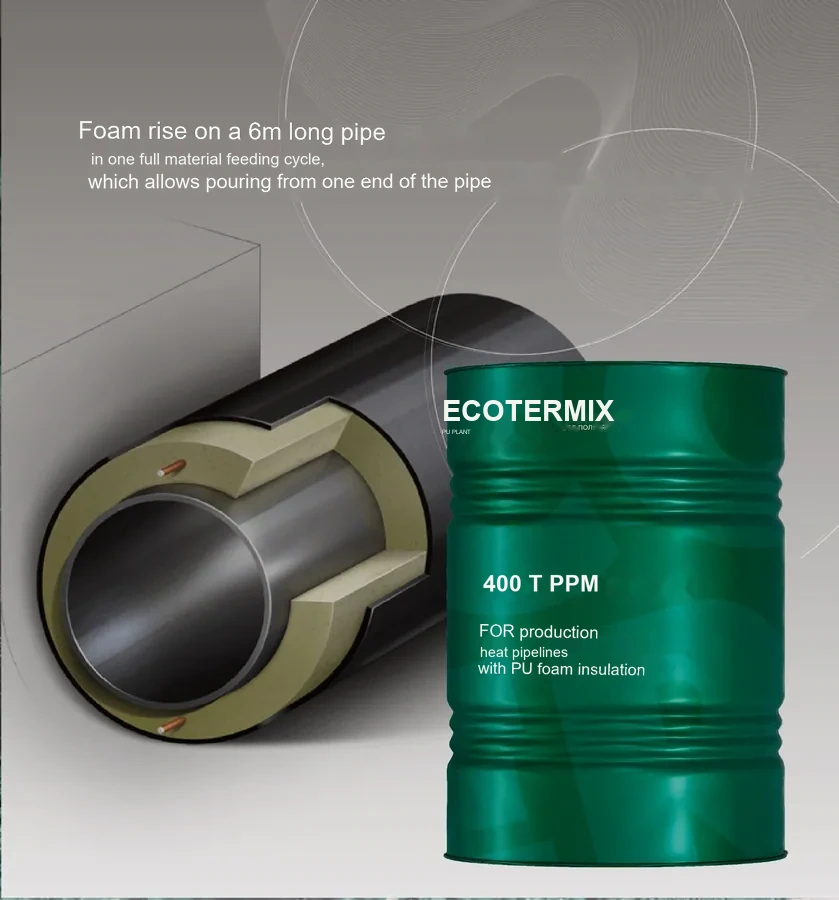
Ecotermix 400 T PPM
Component of the Ecotermix 400 T PPM PU foam system for the production of thermal insulation for pipes with the addition of quartz sand
Details →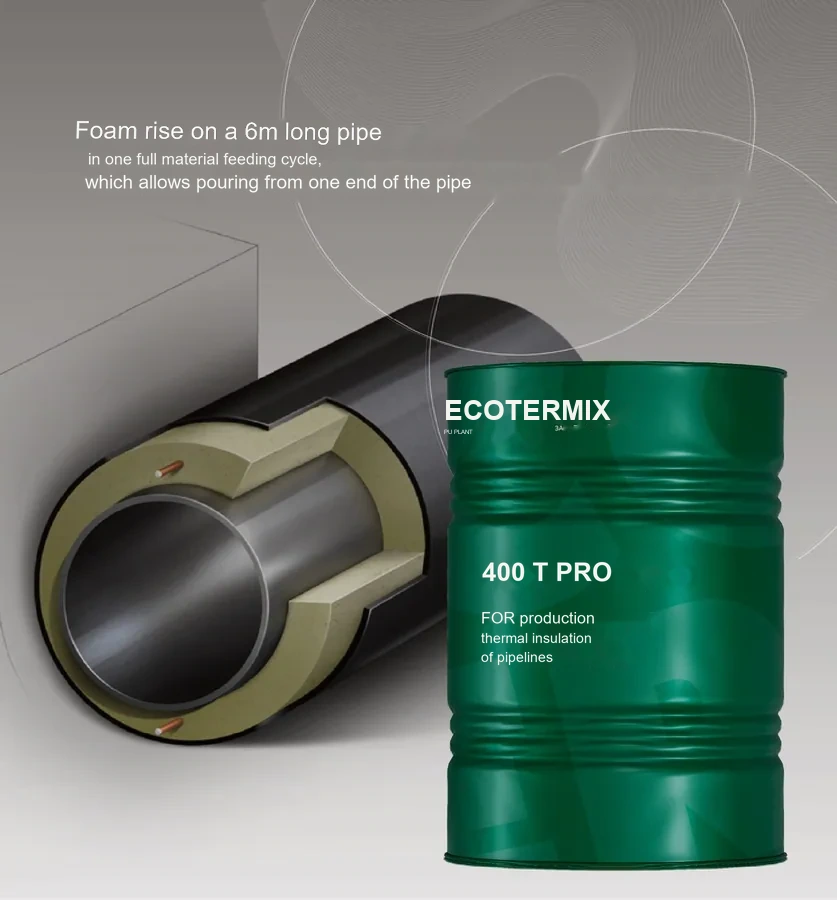
Ecotermix 400 T PRO
PU foam component system "Ecotermix 400 T PRO" for producing thermal insulation of pipelines
Details →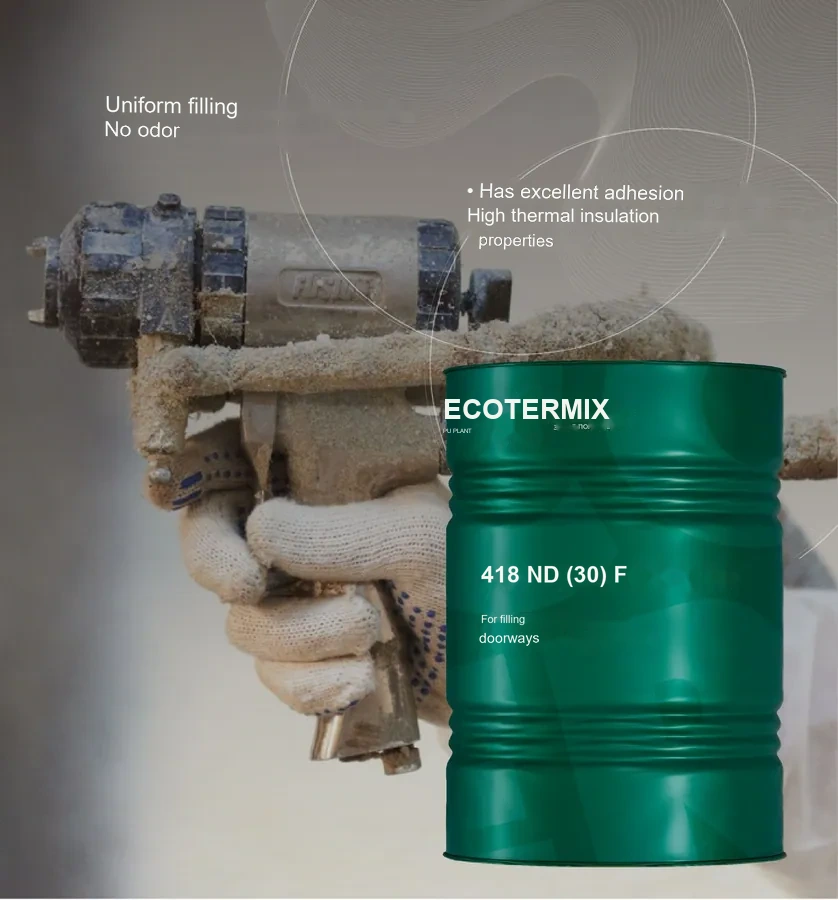
Ecotermix 418HD(30)F
Two-component PU foam system 418HD(30)F Used for manufacturing rigid polyurethane by pour-in-place (casting) method for: thermal insulation of pipelin
Details →Need a quote or technical advice?
Tell us about your application, volumes and destination. Our team will reply with a proposal and technical data sheets.