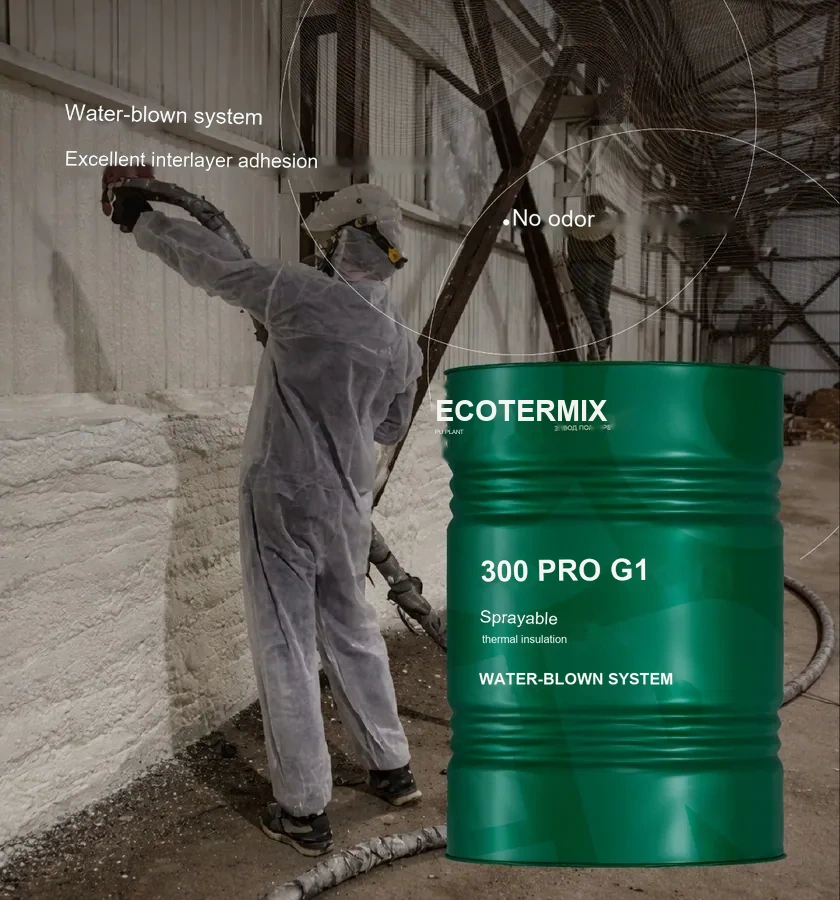
Ecotermix 300 (40) PRO G1
ETM 300 (40) PRO G1 is a two-component system for producing rigid thermal insulation polyurethane foam by spray application onto building structures.
| Blowing agent | Water |
| System weight, kg | 470 |
| Yield per set, m³ | 8.5 – 9.5 m³ |
| Apparent density, kg/m³ | 34 – 45 |
| Application temperature, °C | from +10 |
| Mix ratio A:B (by volume) | 100:100 |
Description
ETM 300 (40) PRO G1 is a two-component system for producing rigid thermal insulation polyurethane foam by spray application onto building structures. When component A (polyol) is mixed with component B (polymeric MDI) in an SPF rig, a foaming chemical reaction occurs, forming a rigid closed-cell foam with a density of 40 kg/m³. The cured coating performs reliably across a temperature range from –40 °C to +300 °C, making the system a sought-after solution for thermal protection of steam and process pipelines, industrial equipment, tanks and metal structures. Flammability class G1 confirms that the material meets the fire safety requirements of oil and gas, power generation and industrial facilities.
The PRO series features an increased concentration of active components in the polyol, providing improved thermal insulation performance of the cured foam with lower system consumption on site. The closed-cell structure of the polyurethane foam ensures low thermal conductivity, high adhesion to metal, concrete and other substrates, as well as additional protection against corrosion and moisture ingress. The spray application method allows uniform coating of surfaces with any geometry - flanges, elbows, tees, weld seams - without cutting or fitting the material. The quality of the system is confirmed by testing to the international standards ASTM D 4889 and ASTM D 891.
Features and benefits of ETM 300 (40) PRO G1
ETM 300 (40) PRO G1 is not just a thermal insulation coating, but a multifunctional, professional-grade protective coating.
- Extreme temperature range
The operating range from –40 °C to +300 °C covers the vast majority of industrial applications - from insulating cold rooms to insulating steam pipelines and industrial furnaces. The coating does not crack, delaminate or lose adhesion under sharp temperature fluctuations. - Flammability class G1 - low-flammability material
The formulation meets the fire safety requirements of industrial and civil facilities. Class G1 means the coating does not sustain combustion or spread fire, which is critical for oil and gas, power generation and manufacturing facilities. - Thermal conductivity of 0.03 W/(m·K)
One of the best figures among liquid thermal insulation coatings. This is achieved through the high content of microspheres with evacuated air inside the formulation. Even 2-3 mm of coating provides a noticeable insulating effect. - Vapour barrier and condensation protection
The coating has low vapour permeability, preventing condensation from forming on surfaces with temperature differentials. This is especially relevant for cold pipelines, ductwork and structures in high-humidity conditions. - Application to surfaces of any geometry
The liquid form allows uninterrupted coating of flanges, elbows, tees, weld seams and other hard-to-reach components - where installing board or roll insulation materials is physically impossible or requires significant labour. - PRO series - enhanced formulation
Compared with the standard ETM range, the PRO series contains an increased concentration of thermal insulation components. This delivers a greater effect with fewer layers and reduces the overall material consumption on site.
Advantages over alternatives
- Operating temperature up to +300 °C - most standard liquid insulation materials are rated for +120–150 °C, and PU foam shells cannot withstand more than +110 °C. Ecotermix 300 (40) PRO G1 is suitable for hot steam and process pipelines without the need to switch materials.
- Application to surfaces of any geometry - flanges, elbows, tees and weld seams are coated by brush or sprayer without the cutting and fitting required for mineral wool and PU foam shells.
- Flammability class G1 - low flammability - most competing liquid formulations are class G2 or do not declare a fire classification at all. PU foam shells fall into class G3–G4.
- Built-in corrosion protection - the alkaline environment of the formulation (pH 12) passivates metal and prevents under-film corrosion. A separate anti-corrosion layer is required when using mineral wool or PU foam.
- High installation speed - application is completed within a single work shift without scaffolding, clamps or fasteners. Installing mineral wool mats and shells is considerably more labour-intensive.
- Simple maintenance and repair - a damaged area can be restored with spot application by brush. Repairing board or roll materials requires dismantling entire sections.
- Minimal load on the structure - a coating thickness of 2–5 mm adds practically no weight to the insulated object, unlike mineral wool mats and rigid shells.
- Application on operating equipment - the coating can be applied without halting production. Installing rigid insulation in most cases requires taking equipment out of service.
- Compliance with international standards - the formulation has been tested to ASTM D 4889 and ASTM D 891, which is important for facilities with foreign technical supervision and international project documentation.
How to purchase ETM 300 (40) PRO G1
To get the current price and purchase this professional liquid thermal insulation system, please submit a request on the website. The product is supplied ready for use - the formulation is fully prepared for application and requires no on-site component mixing, which eliminates dosing errors during application. Special wholesale terms are available for contractors and companies with large volumes of insulation work.
Specifications
Mix ratio
| Name | Parts by mass | |
| Component A | ETM 300 (40) PRO G2 | 100 |
| Component B | Polymeric MDI (PMDI) | 105 |
Physical properties
| Units | Component | Method | |
| Dynamic viscosity | mPa·s | 300–800 (25°C) | GOST 1929-87, ASTM D 4889 |
| Density | kg/cm3 | 1000–1250 (25°C) | GOST 18995.1-73, ASTM D 891 |
| Shelf life | months | 12 |
Reaction characteristics under recommended conditions*
| Value | |
| Appearance | Liquid, white to yellow in colour; slight stratification is acceptable |
| Cream time, s | 2 – 7 |
| Rise time, s | 8 – 18 |
| Apparent density at free rise, kg/m³ | 34 – 45⁴ |
| Appearance of cured PU foam and vertical cross-section structure (visual) | Rigid foam material. Fine-cell structure with a small number of enlarged cells |
| Thermal conductivity, W/m·K | ≤ 0.03 |
| Water absorption (24 h), % | 2 – 5 |
| Flammability class | G1 |
*The data refer to tests performed in accordance with the manufacturer's documentation using a laboratory mixer. Component temperature – 25±0.5°C, mixer speed – 2000 rpm. Mixing time 5 s.
Shelf life
12 months from the date of manufacture when stored in tightly sealed containers. After the shelf life has expired, the product may be used following verification of compliance with the requirements of this technical documentation.
Analogues
Analogues of the «ETM 300 (40) PRO G1» spray polyurethane foam system are two-component PU systems from other manufacturers with a similar flammability class G1 and density - for example, formulations based on rigid closed-cell polyurethane foam for spray application with an operating temperature of up to +300 °C and thermal conductivity in the range of 0.028–0.035 W/m·K. When choosing between materials, it is recommended to check with a technical specialist regarding processing conditions, equipment requirements, component availability and compatibility with the specific site and substrate type.
Related products
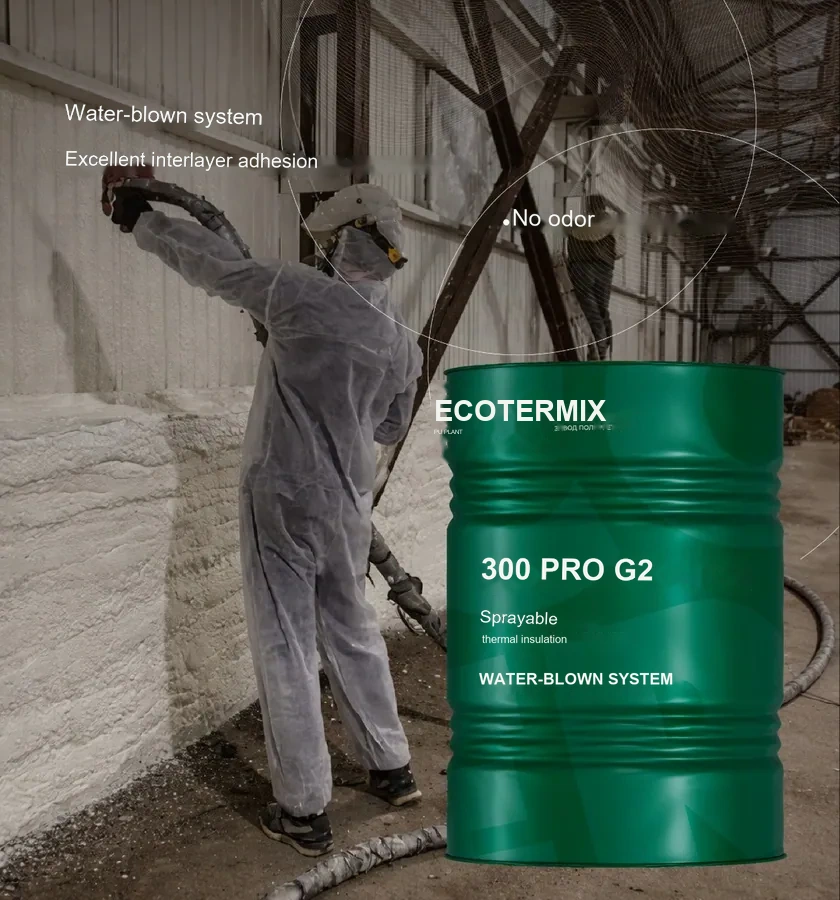
Ecotermix 300 (20) PRO G3
Blowing agent: Water System weight, kg: 470 Yield per set, m³: 17 – 21 Flammability class: G3 Application temperature, °C: from +10 Apparent density,
Details →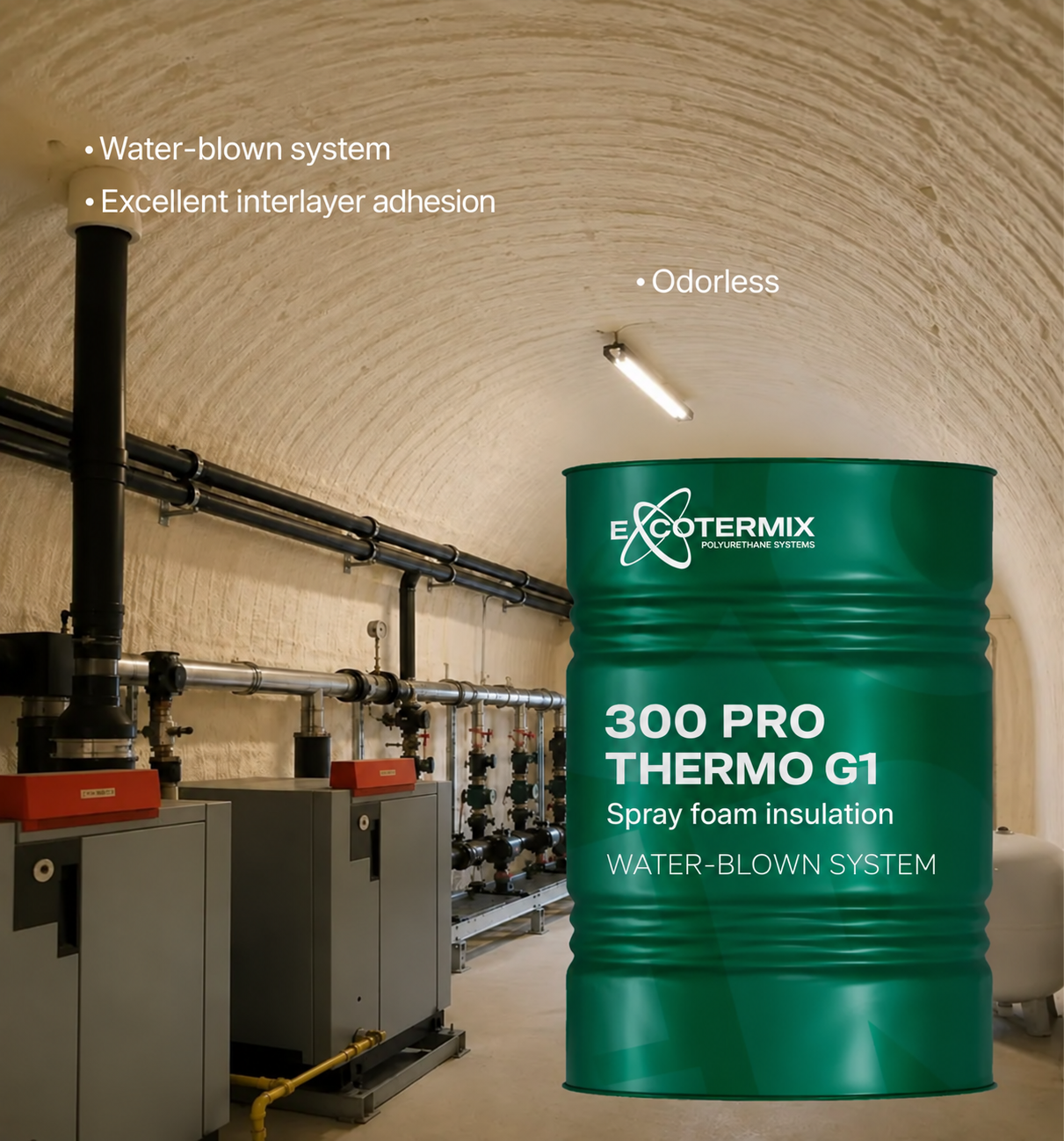
Ecotermix 300 (60) PRO THERMO G1
Blowing agent: Water System weight, kg: 470 Yield per set, m³: 6 – 6.5 Continuous operating temperature, °C: –60 to +150 Flammability class: G1 Appare
Details →Ecotermix 300 (40) PRO THERMO G1
Blowing agent: Water System weight, kg: 470 Yield per set, m³: 8.5–9.5 Continuous operating temperature, °C: –60 to +150 Flammability class: G1 Appare
Details →Ecotermix 300 (50) PRO THERMO G1
Blowing agent: Water System weight, kg: 470 Yield per set, m³: 7 – 7.5 Continuous service temperature, °C: –60 to +150 Flammability class: G1 Apparent
Details →Need a quote or technical advice?
Tell us about your application, volumes and destination. Our team will reply with a proposal and technical data sheets.